Showing posts with label SW ponds. Show all posts

Tuesday, June 17, 2014

flight

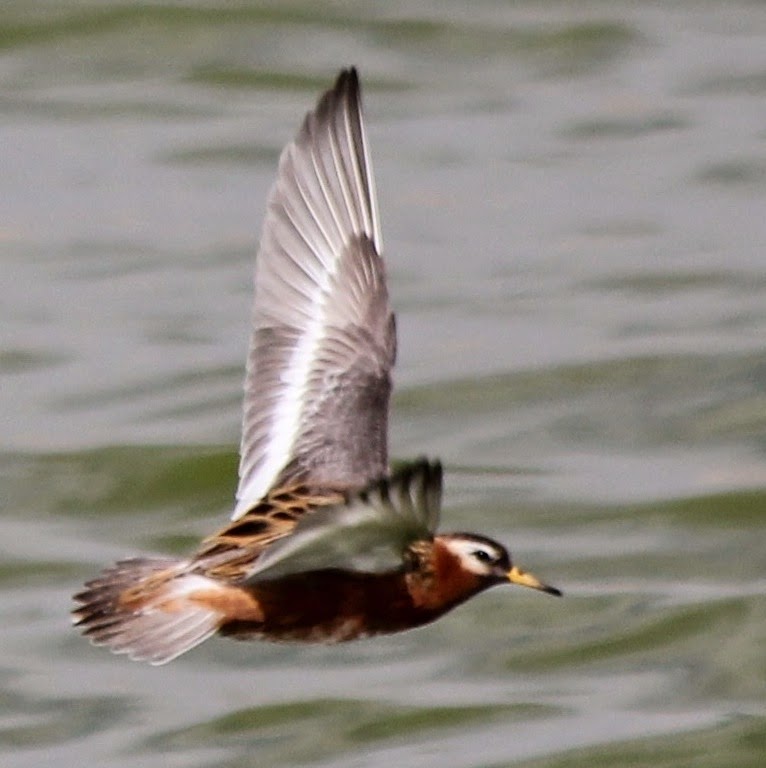
Generally we brace ourselves for one-day-wonders when something cool turns up... the Red Phalarope Dale Ohl found on Sunday stuck around through at least 5:45 pm on Monday, though. That evening we got 1.5 inches of rain in the span of a few hours and by this morning it was gone. No body was found, so we'll just wish her the best.

Blurry, they may be. But what a bird. Absolutely stunning creature. Very fortunate to have crossed paths.

Edit: Carolyn Ohl's post on the Red Phalarope is up on the Christmas Mountains Oasis blog.


Sunday, June 15, 2014

Arctic View

SW Ponds and Red Phalarope in 102 degrees, with Mike Dupree. Photo by Matt York.

Red Phalarope, BREEDING PLUMAGE, Marathon Treatment Ponds - PRIVATE Property

YES, THEY ACTUALLY COME IN RED! And this is the first time I have seen it in breeding plumage. What a thrill!

Remember, this is Private Property. Contact, preferably via text, Heidi for arranging access.

Dale Ohl of Alpine and Canton, TX originally spotted the bird as the three of us ventured to the ponds this morning. More later, perhaps. Here are a few photos:

Red Phalarope (Phalaropus fulicarius)


A general range map for this species:


**range map is from: http://offline.whatbird.com/obj/643/_/Red_Phalarope.aspx

Yes, that orange up there is its summer breeding range.

Sunday, June 8, 2014

Lapland the 5th

Lapland Longspur (Calcarius lapponicus

In our brief four years in Marathon, we have become quite the Longspur enthusiasts. Something about the frozen gusts of wind blasting through your very soul... Who are we kidding? In the last year, access to private ponds has opened up a whole new world of longspur observation: less windy, less cold, lower numbers than the prairie dog town, but better looks.


I digress. This was about Lapland Longspurs. First record for Brewster County was a cat kill at the Marathon Motel. Second was road kill on Hwy 90. Third and fourth were very much alive just north of the prairie dog town on 385, as Matt was able to come and confirm that I was not hallucinating. 

Fifth record... this is June 8th, all self respecting longspurs should have left in late March or late April (McCown's and Chestnut-collared, respectively). But the dark peep foraging on the bank next to a Western Sandpiper and a Baird's Sandpiper... It turned around and looked an awful lot like a Horned Lark. But it just wasn't quite Horned Lark. Silly Lapland Longspur, why are you so geographically confused?

I hereby hand the post over to Matt and a few more of his photos:


Edit: check out the range map for Lapland Longspur in summer!

Monday, May 26, 2014

26 May 2014 SW Ponds / Private

What a difference a day or two makes! We had lower oriole numbers and diversity, higher phalarope numbers, MUCH higher peep numbers and generally similar flycatcher numbers.

White-faced Ibis primary flight feather.
Other than a probable Zone-tailed Hawk on the way to the ponds (FOS ZTHA being seen yesterday), and a White-faced Ibis primary on the berm (none seen since the 3rd, likely due to lack of observers), the eBird list pretty much says it all...

31 Species:

10 Mallard (Mexican) Anas platyrhynchos diazi

2 Blue-winged Teal Anas discors

3 Green-winged Teal Anas crecca

6 Ruddy Duck Oxyura jamaicensis - Accurate count

4 Scaled Quail Callipepla squamata

2 Turkey Vulture Cathartes aura

3 Red-tailed Hawk Buteo jamaicensis

6 Killdeer Charadrius vociferus

2 Spotted Sandpiper Actitis macularius

1 Stilt Sandpiper Calidris himantopus - Pronounced white eyebrow. Taller, longer-necked than neighboring Western SPs. Drooping bill longer than width of head. Tail reminiscent of yellowlegs spp.

5 White-rumped Sandpiper Calidris fuscicollis - In flight, U-shaped broad white rump patch. Comparable in size to nearby Stilt and Western SP. Slightly larger than nearby Spotted SP.

1 Western Sandpiper Calidris mauri - Smaller peep compared to nearby Stilt SP.Clean white underneath w/o connecting collar. Upperside tail whitish with dark middle stripe (inner retrices) above when in flight. Dark legs.

5 Wilson's Phalarope Phalaropus tricolor

3 White-winged Dove Zenaida asiatica

1 Mourning Dove Zenaida macroura
Year + old box turtle shell, sun bleaching.

1 Common Nighthawk Chordeiles minor

1 Say's Phoebe Sayornis saya

2 Ash-throated Flycatcher Myiarchus cinerascens

2 Cassin's Kingbird Tyrannus vociferans

4 Western Kingbird Tyrannus verticalis

3 Scissor-tailed Flycatcher Tyrannus forficatus

4 Barn Swallow Hirundo rustica

2 Cave Swallow Petrochelidon fulva

1 Cactus Wren Campylorhynchus brunneicapillus

1 Northern Mockingbird Mimus polyglottos

3 Lark Sparrow Chondestes grammacus

5 Black-throated Sparrow Amphispiza bilineata

2 Pyrrhuloxia Cardinalis sinuatus

3 Brown-headed Cowbird Molothrus ater

1 Orchard Oriole Icterus spurius

3 Bullock's Oriole Icterus bullockii


The Glass Mountains from the south, as seen from the ponds.

Saturday, May 24, 2014

24 May 2014 SW Ponds / Private

From my Texbirds post:

Better late than never -- yesterday morning's pre-work jaunt to the ponds (private property) with Dale Ohl, Bill Sain, and Julie Oesper yielded an underwhelming variety of waterfowl but an excellent visit overall. I guess the summer waterfowl doldrums are expected by now, but I hadn't anticipated such good oriole diversity: multiple Scott's, Bullocks, and Orchard, and a stray Hooded; last spring one male Hooded stuck around Post Park, but the habitat there is far, far better than at the ponds! One stray Wilson's Phalarope was nice, along with a late, unspotted Spotted Sandpiper.

Otherwise, it was the usual suspects - Lark Sparrow, Curve-billed Thrasher, Vermilion Flycatcher, Yellow-headed Blackbird, Cassin's and Western Kingbirds, Scissor-tailed Flycatcher, Scaled Quail, itty-bitty Killdeerlings, and lots of ruckus from Killdeer parents.

Good birds, good company, what more can you ask for!

***
There's a pond over there somewhere... Dale, Bill, and Julie's shadow.
6 Mallard (Mexican) Anas platyrhynchos diazi
4 Blue-winged Teal Anas discors
3 Ruddy Duck Oxyura jamaicensis
2 Scaled Quail Callipepla squamata
5 Turkey Vulture Cathartes aura
4 Red-tailed Hawk Buteo jamaicensis
9 Killdeer Charadrius vociferus
1 Spotted Sandpiper Actitis macularius
1 Wilson's Phalarope Phalaropus tricolor
8 White-winged Dove Zenaida asiatica
2 Mourning Dove Zenaida macroura
1 hummingbird sp. Trochilidae sp. - likely BCHU
1 Say's Phoebe Sayornis saya
2 Vermilion Flycatcher Pyrocephalus rubinus
2 Ash-throated Flycatcher Myiarchus cinerascens
2 Cassin's Kingbird Tyrannus vociferans
2 Western Kingbird Tyrannus verticalis
2 Scissor-tailed Flycatcher Tyrannus forficatus
1 Bell's Vireo Vireo bellii - heard only by Dale
1 Bank Swallow Riparia riparia
2 Barn Swallow Hirundo rustica
7 Cave Swallow Petrochelidon fulva
1 Curve-billed Thrasher Toxostoma curvirostre
1 Northern Mockingbird Mimus polyglottos
5 Lark Sparrow Chondestes grammacus
1 Yellow-headed Blackbird Xanthocephalus xanthocephalus
3 Great-tailed Grackle Quiscalus mexicanus
1 Bronzed Cowbird Molothrus aeneus
2 Orchard Oriole Icterus spurius
1 Hooded Oriole Icterus cucullatus
3 Bullock's Oriole Icterus bullockii
2 Scott's Oriole Icterus parisorum

* post is backdated for the date of observations, not date of Texbirds post nor compiling of blog post!

Monday, February 17, 2014

Small Checkered Skipper

...and we thought spring was going to wait until March or April... guess we need to bust out the black lights because things really ARE moving! Apologies for the incredibly low photo quality here; this was a VERY fresh Small Checkered Skipper (Pyrgus scriptura) taken at the ponds SW of Marathon yesterday (16 Feb 2014), digital zoom makes it look oddly, unfortunately blocky.

Small Checkered Skipper (Pyrgus scriptura), 16 February 2014, Brewster Co, TX
I recall Small Checkered Skippers being much smaller than this individual seemed (more like Western Pygmy Blues than Common/White Checkered Skippers), and later in the morning we did see a Common/White Checkered Skipper at Post Park - and it really did seem about the same size. Confusing, especially since many early flying leps are smaller than their later-season counterparts.

That said, Post Park and the water crossings on Post Road were FILLED with Mourning Cloaks. Wonderful early fliers, and able to stay aloft in the breeze. Post Road also had a gaggle of pronghorn antelope; they have been absent for some time.

Sunday, June 2, 2013

BBNP and Flame-colored post

Flame-colored Tanager update and Big Bend National Park trip summary on Cameron Carver's blog post over at The Painted Bunny. We owe him a Hooded Oriole for such a great post!

(all tags here reflect the content of his post)

Matt's write-up from a few days later is here.

Saturday, May 18, 2013

year of the phalarope

Wilson's Phalaropes have been exceptionally abundant in the western portion of Texas this spring; generally we do well to find a pair or three during migration every year (this may be a personal bias and lack of water, but we're always looking!)

There were 74 Wilson's Phalaropes at Marathon's treatment ponds on 11 May, up from 55 on 25 April. Numbers had been fluctuating since 7 made their first appearance on 17 April; we'll take what we can get.

Female Wilson's Phalarope, 29 April 2013, Marathon treatment ponds
A bit of reminiscing on my part - growing up on the coast, I was quite familiar with Sanderlings and Willets and Killdeer and staring at the bird book (ignoring measurements, of course), I always thought of phalaropes as duck-sized swans or something of that sort. Surely anything with THAT long and slender of a neck - and swimming habit - had to be a fairly large bird.

My first encounter with Wilson's Phalarope was one of frustration: a tiny gray and white sandpiper with a long neck was SWIMMING. Spinning. Jabbing at the surface of the water mid-spin. It was chaos. This was no swan. It was not even Willet sized!

Female Wilson's Phalarope, 29 April 2013, Marathon treatment ponds
Unfortunately for us, 'phalarope' doesn't tend to conjure quite the mental image that it could - you can't mistake a goldfinch in breeding plumage, but 'phalarope' doesn't give you the luxury of knowing what you're looking at - or looking for. I'd vote for 'swimpiper' because it's definitely not a sandpiper and if a 4 year old can identify a sandpiper, I'd be willing to bet that the same 4 year old could ID a swimpiper.

Wilson's Swimpiper. My apologies to taxonomists, who are weeping just reading this. Tissue?

Thursday, April 25, 2013

on the move

Everything is on the move; Pectoral Sandpipers and Rusty Blackbirds and Pronghorn Antelope, oh my! People, too. So in our posting absence, please accept this offering of other wildlife on the move.

Bees swarming a cottonwood at Post Park, 17 April 2013

Yellow-headed Blackbirds near the Double Bacon Ranch, 21 April 2013

Bullsnake crossing Post Road, 17 April 2013

Bullsnake crossing Post Road, 17 April 2013

Wilson's Phalaropes at the SW ponds in Marathon, 17 April 2013

Wilson's Phalaropes at the SW ponds in Marathon, 17 April 2013

Wilson's Phalaropes at the SW ponds in Marathon, 17 April 2013

Wilson's Phalaropes at the SW ponds in Marathon, 17 April 2013

Saturday, April 20, 2013

Marathon 'patch' news

Starting with a butterfly update from the south side of town...
1 Common Streaky-skipper (Celotes nessus)

Monarchs are still trickling through in single digits along with Checkered Whites; there's so much birding to be done that the butterflies have mostly been incidental!

This week's birding along Post Road and at Post Park (* denotes new arrivals):

Scaled Quail (Callipepla squamata)
Wild Turkey (Meleagris gallopavo)
Pied-billed Grebe (Podilymbus podiceps)*
Turkey Vulture (Cathartes aura)
Cooper's Hawk (Accipiter cooperii)
American Coot (Fulica americana)
Killdeer (Charadrius vociferus)
Eurasian Collared-Dove (Streptopelia decaocto)
White-winged Dove (Zenaida asiatica)
Mourning Dove (Zenaida macroura)
Black-chinned Hummingbird (Archilochus alexandri)
Golden-fronted Woodpecker (Melanerpes aurifrons)
Ladder-backed Woodpecker (Picoides scalaris)
Vermilion Flycatcher (Pyrocephalus rubinus)
Ash-throated Flycatcher (Myiarchus cinerascens)
Western Kingbird (Tyrannus verticalis)
Bell's Vireo (Vireo bellii)
Cassin's Vireo (Vireo cassinii)*
Northern Rough-winged Swallow (Stelgidopteryx serripennis)*
Barn Swallow (Hirundo rustica)
Cave Swallow (Petrochelidon fulva)
Verdin (Auriparus flaviceps)
Marsh Wren (Cistothorus palustris)
Cactus Wren (Campylorhynchus brunneicapillus)
Northern Mockingbird (Mimus polyglottos)
American Pipit (Anthus rubescens)
Common Yellowthroat (Geothlypis trichas)
Yellow-rumped Warbler (Setophaga coronata)
Wilson's Warbler (Cardellina pusilla)
Yellow-breasted Chat (Icteria virens)*
Spotted Towhee (Pipilo maculatus)
Canyon Towhee (Melozone fusca)
Cassin's Sparrow (Peucaea cassinii)
Brewer's Sparrow (Spizella breweri)
Lark Sparrow (Chondestes grammacus)
Black-throated Sparrow (Amphispiza bilineata)
Lark Bunting (Calamospiza melanocorys)
Lincoln's Sparrow (Melospiza lincolnii)
White-throated Sparrow (Zonotrichia albicollis)
White-crowned Sparrow (Zonotrichia leucophrys)
Summer Tanager (Piranga rubra)
Pyrrhuloxia (Cardinalis sinuatus)
Red-winged Blackbird (Agelaius phoeniceus)
Rusty Blackbird (Euphagus carolinus)
Hooded Oriole (Icterus cucullatus)*
House Finch (Haemorhous mexicanus)
Pine Siskin (Spinus pinus)


Rusty Blackbird, Post Road 19 April, 2013


Rusty Blackbird, Post Road 19 April, 2013


Marathon "patch" outside of Post:

Gadwall (Anas strepera)
American Wigeon (Anas americana)
Mexican Mallard (Anas platyrhynchos)
Northern Shoveler (Anas clypeata)
Green-winged Teal (Anas crecca)
Bufflehead (Bucephala albeola)
Ruddy Duck (Oxyura jamaicensis)
Eared Grebe (Podiceps nigricollis)
Cattle Egret (Bubulcus ibis)*
Spotted Sandpiper (Actitis macularius)
Wilson's Phalarope (Phalaropus tricolor)*
Inca Dove (Columbina inca)
Say's Phoebe (Sayornis saya)
Cassin's Kingbird (Tyrannus vociferans)
Scissor-tailed Flycatcher (Tyrannus forficatus)*
Cliff Swallow (Petrochelidon pyrrhonota)
Curve-billed Thrasher (Toxostoma curvirostre)
Brown-headed Cowbird (Molothrus ater)

"Patch" highlights from the previous week:

Franklin's Gull (Leucophaeus pipixcan)
Plumbeous Vireo (Vireo plumbeous)*
Friday, April 5, 2013

a little early, a little lost

What yonder haze doth obscure...


Pectoral Sandpiper (Calidris melanotos)


Pectoral Sandpipers have been known to pass through the Trans-Pecos in low numbers in April; the individual above was photographed at the ponds SW of Marathon (publicly inaccessible, unfortunately) on March 31st. So this bird is not only a bit out of range, but also a bit early and due to backlighting and heat haze, less than photogenic. But we're not hung up on the art so much as the documentation...

Incomplete list from the ponds:
American Wigeon
Mallard (Mexican)
Northern Shoveler
Ring-necked Duck
Ruddy Duck
Turkey Vulture
American Coot
Lesser Yellowlegs
Least Sandpiper
Pectoral Sandpiper
Wilson's Snipe
Say's Phoebe
Barn Swallow
American Pipit
Chestnut-collared Longspur