I realize this is an odd pulse in posting since the blog has lapsed into silence: Matt is still in CA, I am still in MI. Both indefinitely. I've unsubscribed from the Brewster and Reeves County eBird alerts because my heart just can't take the beating. What news I do get comes from folks who haven't heard, and would like to know if I'll be around when they're in town. Lest I get too nostalgic, let's just say that it's kind of nice to not feel the weight of citizen science on my shoulders every time I'm out birding: Washtenaw County, Michigan has PLENTY of birders who are reporting their sightings.
Reminiscing aside, have some content! This post is not sighting related, obviously, but optics are optics and we've fielded questions about cameras and binoculars in the past - might as well share the learning curve. (Camera reviews may be forthcoming, but Lillian Stokes nails the epic point-and-shoot that is the Canon SX 50 in her review - and warns away from the 60)
A brief history of my binoculars:
Bushnell 7x35s circa 1997-2000
Price: I don't remember, but definitely well under $100 (donated* circa 2003)
Eagle Optics Rangers 8x42 circa 2000-2015
$350? sounds about right
Audubon (Swifts?) 7x35(??) 2003
Won during the Great Texas Birding Classic, donated immediately due to being completely useless for my eyes - retail was probably well under $200
Nikon Monarch 8x42 circa 2007-2014
Gifted to me as spares ~$250? Not sure.
Opticron Traveller** 8x32 2015
Listed around $370, paid closer to $320 due to festival discount.
* Binoculars were donated to the American Birding Association's Birder's Exchange program.
** Zeiss Terra ED 8x32 were ALMOST on the list where the Opticron Traveller now sits. For three long, drawn out, agonizing years, I bided my time, procrastinating. Mostly being too broke to justify replacing the EO Rangers, and too complacent with the Nikon Monarchs as backups. Why the final snap? Everything in my life has completely and utterly been destroyed. Field work in 2014 nailed the coffin on the Nikons (I was chipping GLASS on them - screw destroying the coating, I was annihilating the actual LENS that my left eye was looking through... moral of the story is don't tuck your bins under your left arm when hiking for two months straight and also carrying a clipboard that bumps the eyepiece - or something...) so the Nikons were put into retirement. Then the portion of body where the strap is secured... snapped. My Rangers literally had one connecting point for the strap. Lopsided binoculars + redneck engineering = babied them along for another year, almost. In the meantime, I'd already done my homework to replace the Nikons, but didn't want to think about the cost (upper limit: mortgage payment, lower limit: dog food).
My requirements:
Top priority - IPD of 54 mm or less. IPD stands for Interpupillary Distance. It's pretty irrelevant if you have a big head. Or a medium head. Or are an average-sized human. I weigh roughly 105 lbs soaking wet, and while I might have a huge ego, my head is relatively proportionate to the rest of me. This is problematic. EVERY decent pair of binoculars on the planet* has a minimum IPD of 55 mm or wider (*pers observation, additional citation needed). When looking through binoculars, vignetting and separate-circles are quite problematic if you're trying to actually see/watch anything, much less birds or butterflies. Spoiler: none of the bins that I owned actually fit me 100% and it led to headaches early on and not really using my bins much. The EOs did have decent eye-relief (more on that soon!) which helped a bit. They were definitely better than the Monarchs in that regard.
Second(?) priority - eye relief! I wear glasses. Really, it's tied as top priority. But you have to have them up to your eyes to know the difference. And if they don't work, there's no way you can make them work. Try holding up a pair of cardboard tubes to your eyes... you don't want the tiny light at the end of the tunnel. You want as much of a view in your eyeballs as you can stand. Hands-on testing is required to determine this rather personal fit.
Third priority - close focus! I like big bugs and I cannot lie. But I also enjoy small bugs. And medium bugs. And sometimes they're pretty close to me, so I want to look at them without stepping back a few feet and falling off the side of a cliff. Not that I'm generally bug watching on cliffs, but if I can focus on my toes, I'm happy (admittedly, I'm short... soooo....). The EO Rangers had a close focus that, on tip-toe, was essentially perfect. My spare Nikons would have required me to grow another foot in height to focus on my toes. Meh. Forget about close focus on those first Bushnells, and the Swifts, too. Anything over 8' isn't close anymore.
Fourth priority - size/weight/feel. I don't mind a bicep workout if there's good quality, but I have smallish hands and I don't want a sore neck/back/arm/whatever. I have used - and love - "branocular" harnesses (harnesses with the center-point in the back) because they do distribute weight nicely, but ultimately I wanted something on the smaller end of full-sized binoculars in spite of the improved weight distribution. If you can't hold/lug your bins for hours, you're not going to be happy 15 years later. In the process of deciding on my EO Rangers, I went to an optics fair at Armand Bayou Nature Center (circa 2000) and picked up literally every pair of bins that was 7-8x and after figuring out the closest IPD fit (which wasn't perfect, but mini-bins were not on the menu for me at the time - I wanted to go from 7x35 to 8x at least), the last ones - the ones I couldn't bear to put down - were the Rangers and... I think a pair of Leicas. But there's a pretty hefty difference between $350ish and $800 or whatever it was, especially for a broke high school student.
Research: I poured through Cornell's Binocular Review for hours, among other things.
Bottom line:
Times have changed a bit and I'm no longer in high school (thank goodness), but sometimes I feel that the limitations are the same - parents and dogs are about on par for being restrictive to birding lifestyles. Oddly, finances are almost similar. Give or take a car payment. On the bright side, The Biggest Week in American Birding was perfect for optics shopping and I walked away with a VERY lightweight, crisp, bright, compact set of amazing optics. The poor fellow who worked the Opticron booth, Paul, was exceptionally patient (seeing as he's been trying to set me up with a pair of bins since 2012 or so!) as I tested the Opticron Travellers and Zeiss Terra EDs side by side for the better part of an hour, intermittently, over the first weekend of the festival. I'm thankful that the Travellers were so new that I wasn't already familiar with their spec sheet - had I been familiar with their claim of a 57 mm IPD, I don't think I ever would have even picked them up. The eye cups PULL rather than twist up/down, but unless I'm handing off my bins to people who aren't wearing glasses, I don't see that as a problem. Since I wear glasses I also don't have to worry about one eye being focused differently than the other, so that's handy - rumor has it that it's a beast to twist the right lens into focus... as it should be. The gear included was pretty basic - lens cloth, case, thin strap, eye covers that I didn't put on (because I'm lazy and/or would lose them). Unfortunately because the glass is so exposed I will probably beat them up a bit faster than the other pairs of bins, judging by my historical use. I can't wait to find out, though!
Costs: How I finally calculated what I, personally, was willing to spend...
Historical mortgage payment
One month's rent with average utilities
One month's therapy costs
Current vehicle payment
Weekly income
Adoption fee for dog
A year's worth of dog food
....average of all of the above. No numbers, you can guess.
It just needed to be a number that wouldn't raise my blood pressure to the point of absolute panic. The Laura Erickson method also applied: I couldn't spend more than I could reasonably afford to replace. Let's go with DEAR GOD I HOPE I DON'T HAVE TO REPLACE THEM. Because, really, life's a bit too unpredictable for that right now.
Maybe there will be photos of my beat up bins here at some point; for now I hope the horrifying descriptions will keep people pampering their optics as much as possible! Recreational birders may not abuse their bins as much, but it's worth thinking about. There are no right/wrong answers with optics - binoculars are like snowflakes and fingerprints and birders/butterfliers/dragonfliers/moth-ers/herpers will all have something different they want. The good news: it's all out there.
Happy trails!!

Blogging from Marathon, TX about birding, butterflies, moths and more. Exploring the gems of Brewster County, Post Park, Big Bend National Park and the surrounding region. Bird watching: Big Bend and beyond!
Showing posts with label Q and A. Show all posts
Showing posts with label Q and A. Show all posts
Saturday, May 23, 2015


Sunday, January 5, 2014
Welcoming the New Year
Last year put us through the wringer in just about every way you can imagine: we're thankful that 2013 is behind us! The year did wrap up with a bit of a media flurry, however, and everything just hit at once: NPR beat the Wall Street Journal by one day (Jan 2 and 3), and the Cenizo Journal has just gone to press. Not bad for the first week of 2014, eh?
As in all things media, KRTS/NPR's Nature Notes started out loosely based around the "feathers" topic, and ended up re-written entirely a few times before being re-written again after submission. But, hey, my mom was really excited about it, and that's what counts! This makes a cumulative three instances in which Matt and I have ended up on KRTS in the name of birds/nature.
Click here to hear about feathers on KRTS. (Brown creeper context here.)
The Wall Street Journal piece was incredibly thorough: more than a dozen birders were interviewed at length and the results were comprehensive as well as... a bit strange. I spent a lot of time griping about how casual playback during a drought is irresponsible and could cost the birds their lives (no, really, there are a TON of dead bird posts from 2011 on this blog) so that wasn't really directly related to the Brown Thrasher anecdote. While Matt was not quoted, he was interviewed and contributed context.
Nonetheless, check it out: Birders Use Smartphones to Play Bird Songs.
Next up: we'll keep y'all posted as we hear more from the Cenizo Journal. It's a bit of a double-feature, weighing Aplomado Falcons and Great Horned Owls in the region!
(Our last print mention was in August 2012, in Texas Monthly. Keep scrolling, we're down there in the "Bookmark" section!)

Birding requires bins, boots, and a book. Camera optional. Actually, all of that is optional. Just get out there and enjoy nature with respect. We'll see you on the trails!

As in all things media, KRTS/NPR's Nature Notes started out loosely based around the "feathers" topic, and ended up re-written entirely a few times before being re-written again after submission. But, hey, my mom was really excited about it, and that's what counts! This makes a cumulative three instances in which Matt and I have ended up on KRTS in the name of birds/nature.
Click here to hear about feathers on KRTS. (Brown creeper context here.)
The Wall Street Journal piece was incredibly thorough: more than a dozen birders were interviewed at length and the results were comprehensive as well as... a bit strange. I spent a lot of time griping about how casual playback during a drought is irresponsible and could cost the birds their lives (no, really, there are a TON of dead bird posts from 2011 on this blog) so that wasn't really directly related to the Brown Thrasher anecdote. While Matt was not quoted, he was interviewed and contributed context.
Nonetheless, check it out: Birders Use Smartphones to Play Bird Songs.
Next up: we'll keep y'all posted as we hear more from the Cenizo Journal. It's a bit of a double-feature, weighing Aplomado Falcons and Great Horned Owls in the region!
(Our last print mention was in August 2012, in Texas Monthly. Keep scrolling, we're down there in the "Bookmark" section!)

Birding requires bins, boots, and a book. Camera optional. Actually, all of that is optional. Just get out there and enjoy nature with respect. We'll see you on the trails!

Monday, November 11, 2013
101 Ways to Help Birds
How it took me a gazillion years to get my hands on a copy of 101 Ways to Help Birds is beyond me. I'm not sure how I wasn't aware of it's existence; or if I was, how I didn't have a copy (or three).
Laura Erickson has put into words the fleeting thoughts that have slipped in and out of my consciousness for as long as I can remember: I want to help birds. I want to do as much as I can. I want to live in such a way that I take only pictures and leave only footprints... but we have to brush our teeth, and make a living, so... baby steps.
The book is divided into cohesive sections that walk you through your own life. A topic is addressed; a suggestion made. Factoids, history, big picture context is presented to accompany the point: the information is neither so overwhelming nor depressing that it feels like the end of the world (no sense of impending doom), but it is not sugar coated, either. Of course, every section could be a book unto itself, so keeping the information thorough and concise must have been a tremendous challenge; folks wishing to delve deeper on these topics may also wish to check the book's site (there's a DDT update worth consideration).
It's like No Impact Man - but the connections all lead back to birds. I'd read No Impact Man a few years ago and was wondering why birders didn't see the connections. It was a bit more preachy and assumed that folks could afford the changes; 101 Ways doesn't make you feel guilty for only being able to make little changes here and there, it makes you ponder the options under your nose without the sense of "MY LIFE HAS BEEN ALL WRONG" that some conservation minded books seem to imply.
Indispensable. For everyone. And with an excellent reference collection in the back.
Five stars.
Disclaimer: Laura Erickson is someone I had heard of, sort-of-knew on Facebook, and then visited us during her Conservation Big Year; we clicked, we nerded out, she bestowed upon us a copy of her National Geographic Pocket Guide to the Birds of North America (an excellent 'hook' book - doesn't cover all species in the area, but is user friendly and certainly appropriate for non-birding audiences!) and next thing I know, there's a copy of 101 Ways in the mail for me.
Laura Erickson has put into words the fleeting thoughts that have slipped in and out of my consciousness for as long as I can remember: I want to help birds. I want to do as much as I can. I want to live in such a way that I take only pictures and leave only footprints... but we have to brush our teeth, and make a living, so... baby steps.
The book is divided into cohesive sections that walk you through your own life. A topic is addressed; a suggestion made. Factoids, history, big picture context is presented to accompany the point: the information is neither so overwhelming nor depressing that it feels like the end of the world (no sense of impending doom), but it is not sugar coated, either. Of course, every section could be a book unto itself, so keeping the information thorough and concise must have been a tremendous challenge; folks wishing to delve deeper on these topics may also wish to check the book's site (there's a DDT update worth consideration).
It's like No Impact Man - but the connections all lead back to birds. I'd read No Impact Man a few years ago and was wondering why birders didn't see the connections. It was a bit more preachy and assumed that folks could afford the changes; 101 Ways doesn't make you feel guilty for only being able to make little changes here and there, it makes you ponder the options under your nose without the sense of "MY LIFE HAS BEEN ALL WRONG" that some conservation minded books seem to imply.
Indispensable. For everyone. And with an excellent reference collection in the back.
Five stars.
Disclaimer: Laura Erickson is someone I had heard of, sort-of-knew on Facebook, and then visited us during her Conservation Big Year; we clicked, we nerded out, she bestowed upon us a copy of her National Geographic Pocket Guide to the Birds of North America (an excellent 'hook' book - doesn't cover all species in the area, but is user friendly and certainly appropriate for non-birding audiences!) and next thing I know, there's a copy of 101 Ways in the mail for me.
Monday, February 18, 2013
Christmas Mountains Research Symposium
 |
| Varied Thrush (Ixoreus naevius) Christmas Mountains Oasis -- Matt York 22 October 2012 |
Christmas Mountains Research Symposium
May 13-15, 2013
Terlingua Ranch Headquarters, Brewster County, Texas
The objective of the Christmas Mountains Research Symposium is to increase the public and scientific understanding of the ecology, geology, culture, and history of the Chihuahuan Desert Ecosystem, spanning West Texas and Mexico on either side of the Rio Grande.
The two-day symposium will highlight research by students and faculty from universities in the Texas State University System, and welcomes contributions from researchers from other universities, federal, and state agencies, as well as residents of the region who have investigated various aspects of the region’s ecology, geology, culture and history.
The format will be 15-minute talks followed by 5 minutes of questions and discussion. Slides and powerpoint presentations will be supported, but are not required.
The symposium will begin with a Welcome Barbecue and Pool Party beginning at 7 pm. on Monday, May 13. Each of the two days will have a field trip in the morning, and presentations from 1 to 6 in the afternoon. The symposium will close with a steak dinner on the patio Wednesday Evening, May 15. Participants may wish to depart on Thursday, May 16, but are welcome to stay and spend more time exploring the area on their own. The $40 registration fee will cover the opening and closing dinners. All other meals are “on your own,” as well as any alcoholic beverages (wine and beer are served by the Bad Rabbit Cafe). Any local residents not planning to attend the opening and closing dinners may attend the symposium free of charge.
Those wishing to make a presentation should submit an abstract of the proposed talk by March 20, 2013. Abstracts will be evaluated by the symposium organizing committee and successful applicants will be notified by April 15. Abstracts must include the general topic (ecology, geology, culture, history), the title of the talk, the names of the authors, with the speaker listed first, and a description of the main points not to exceed 350 words (see attached example).
Accommodations at Terlingua Ranch include 32 motel-style cabin rooms (two double beds) at $68 per night for one person (check with frontdesk@terlinguaranch.com for reservations and rates) , RV hookups at $20 or $24 per night, and camping at $5 per person per night. In addition, there are also Bed-and-Breakfast accommodations and cabin rentals in the area. A full-service restaurant is open on site 6:30am – 9:00pm daily (reduced hours on Sunday).
The Symposium is sponsored by the four universities of the Texas State University System: Texas State University, Sam Houston State University, Sul Ross State University, and Lamar State University.
Organizing Committee: Michael Huston, David Lemke, and Ivan Castro-Arellano, Texas State;
Kevin Urbanczyk, Sul Ross; Jerry Cook, Sam Houston; Jim Westgate, Lamar.
Abstracts should be sent by email (as Word Documents, or rtf) to Michael Huston, hustonma@txstate.edu, no later than March 20, 2013.
Friday, February 1, 2013
Planning a 2013 trip? Important information!
Howdy, readers!
We have good news and better news and some general requests:
Good news - we're guiding, but you already knew that.
Better news - we're simultaneously trying to shuffle a new job, purchase a house and juggle about a dozen barrels of monkeys who are opening cans of worms. Please bear with us.
Requests:
If you would like to contact us about guiding availability, PLEASE email us at heidi@bigbendnature.com or matt@bigbendnature.com with the word "guiding" or "birding" somewhere in the subject line. Please reserve calling for last-minute and/or urgent requests. If we don't get back to your email within two days, the spam folder may be to blame (alternately, you may try h.trudell at gmail.com or mwayork at gmail.com as well).
Please also let us know if your schedule is firm or flexible; we may have more options mid-week than on weekends, but if we know far enough in advance, may be able to accommodate your schedule. If we're unavailable or booked at any given time, contact us anyway - if anyone cancels or we have last minute schedule changes, we'd be happy to accommodate you!
We're teaming up with Cameron Carver for the spring to help as many folks as possible; alternately, folks wishing to be guided in Big Bend National Park are encouraged to contact Mark Flippo of http://www.birdingbigbend.net/ . We have similar pricing guidelines though we do not currently guide within the park - we do offer discounts for guiding within 15 miles of Marathon to avoid the fuel surcharges. Hotspots within 15 miles of Marathon include the Prairie Dog Town, Gage Gardens, Post Road/Post Park and other local gems, so it provides an economical option for folks wishing to brush up on regional birds before making the target runs to BBNP!
As of right now here's our Spring-Summer 2013 schedule, subject to change:
February -
Cameron - available, depending on schedule
Heidi - unavailable* (*drop a note in case plans change!)
Matt - unavailable*
March -
Cameron - available, depending on schedule
Steve Gross - available March 10-16
Heidi - available for local morning trips mid-week only, otherwise booked 10th-15th
Matt - unavailable*
April - first half of the month is open; second half of the month is filling up quickly!
Cameron - available, depending on schedule
Heidi - available for local morning trips mid-week only
Matt - unavailable*
May - first two weeks are booked for just about everyone, second half of the month is open!
Cameron - booked first week, otherwise available, depending on schedule
Heidi - available for local morning trips mid-week only, otherwise booked 5th-10th
Matt - booked 1st-15th
June - open
July - open
August - booked for the first two weeks
Thanks so much for trusting us with your wish lists, target birds, and general introductions to the region - it's been a great pleasure to help plan trips and assist with local information. We're looking forward to a birdy spring!
Happy trails,
-Heidi & Matt
We have good news and better news and some general requests:
Good news - we're guiding, but you already knew that.
Better news - we're simultaneously trying to shuffle a new job, purchase a house and juggle about a dozen barrels of monkeys who are opening cans of worms. Please bear with us.
Requests:
If you would like to contact us about guiding availability, PLEASE email us at heidi@bigbendnature.com or matt@bigbendnature.com with the word "guiding" or "birding" somewhere in the subject line. Please reserve calling for last-minute and/or urgent requests. If we don't get back to your email within two days, the spam folder may be to blame (alternately, you may try h.trudell at gmail.com or mwayork at gmail.com as well).
Please also let us know if your schedule is firm or flexible; we may have more options mid-week than on weekends, but if we know far enough in advance, may be able to accommodate your schedule. If we're unavailable or booked at any given time, contact us anyway - if anyone cancels or we have last minute schedule changes, we'd be happy to accommodate you!
We're teaming up with Cameron Carver for the spring to help as many folks as possible; alternately, folks wishing to be guided in Big Bend National Park are encouraged to contact Mark Flippo of http://www.birdingbigbend.net/ . We have similar pricing guidelines though we do not currently guide within the park - we do offer discounts for guiding within 15 miles of Marathon to avoid the fuel surcharges. Hotspots within 15 miles of Marathon include the Prairie Dog Town, Gage Gardens, Post Road/Post Park and other local gems, so it provides an economical option for folks wishing to brush up on regional birds before making the target runs to BBNP!
As of right now here's our Spring-Summer 2013 schedule, subject to change:
February -
Cameron - available, depending on schedule
Heidi - unavailable* (*drop a note in case plans change!)
Matt - unavailable*
March -
Cameron - available, depending on schedule
Steve Gross - available March 10-16
Heidi - available for local morning trips mid-week only, otherwise booked 10th-15th
Matt - unavailable*
April - first half of the month is open; second half of the month is filling up quickly!
Cameron - available, depending on schedule
Heidi - available for local morning trips mid-week only
Matt - unavailable*
May - first two weeks are booked for just about everyone, second half of the month is open!
Cameron - booked first week, otherwise available, depending on schedule
Heidi - available for local morning trips mid-week only, otherwise booked 5th-10th
Matt - booked 1st-15th
June - open
July - open
August - booked for the first two weeks
Thanks so much for trusting us with your wish lists, target birds, and general introductions to the region - it's been a great pleasure to help plan trips and assist with local information. We're looking forward to a birdy spring!
Happy trails,
-Heidi & Matt
Sunday, January 6, 2013
Looking back on 2012
2012 in review... something of a daunting task, but we generally do a semi-annual update and the timing is about right for one. Let the festival of links begin!
Changes and challenges:
In somewhat exciting news, we've decided to branch out a bit - we've always done informal guiding, but now we've actually listed regional guiding here on the blog. Regardless of skill level, we're more than happy to introduce folks to the birds (and butterflies) or general nature of the region; Marathon is our home turf, but as long as our schedules work out, we're quite happy to help out with Balmorhea, the Davis Mountains and whatever else suits you. Year listers, county listers, target birding or simply soaking up the region - we'd be happy to help.
It was also in 2012 that eBird reviewing for Reeves and Pecos Counties fell into play: Pecos hasn't even been touched yet, but the learning curve has gone from vertical to... still pretty steep. It's all in the name of progress, right? Speaking of progress, there's another Sul Ross State University grad in the family! After 9 years, 7 moves, 3 schools and 2 states, Heidi finished ~160 hours of a B.A.
This was also the first year that both of us were recruited to co-lead trips for the Rio Grande Valley Birding Festival. For 2011 we were tied up with a booth, so 2012 was a bit more freeing, even if that free time was used to track down speaker/sponsor/leader people for the summer festival!
Last year saw 131 blog posts here, peaking in July with 20 posts. Can't imagine why... we only assembled the finest crew of Texas birders with Kenn and Kimberly Kaufman in attendance!
Blog factoids and people aside, it was quite a year for birds in our region (roughly Brewster, Jeff Davis and Reeves Counties), including but not limited to:
January - Nutting's Flycatcher, a life bird for both of us!)
April - Swainson's and Hermit Wablers
August - Black-billed Cuckoo, Black-throated Green Warbler
October - Sabine's Gull - another double life bird, Varied Thrush, Surf Scoter and Red Phalarope
November - Williamson's Sapsucker* (usually in Jeff Davis Co, not Marathon!)
December - Red Crossbill - it most certainly has been Winter of the Crossbills, and not just for our region. They've been reported all over the southern states and throughout much of Texas. In December we also snuck off to Lubbock to see a double-life Northern Shrike!
Most cooperative non-passerine of the year goes to a pair of Zone-tailed Hawks that cooperated for the festival, tending to their large nestling (still in nest) in front of a group of ~15 or so folks!
...but let's not forget the butterflies that made this year amazing:
Palmer's Metalmark stole the show for the entire summer and well into fall. Common Mestras made an exceptional appearance nearly daily in our yard - not that they ever landed - and made a surge throughout the state. And Big Bend? Diversity was fantastic, and we only made it down there a few times! The festival list was also quite impressive.
Moths took on a whole new meaning to us in 2012, with regular sessions: Summer was great for blacklighting big moths and medium moths and little moths, but the fall threw amazing diversity at us. Biggest miss of the year: Mexican Agapema. We must have slept through it. But, really, the mothy highlight of the year: Plagiomimicus olvello, our beloved Planet Arium Moth.
It will be interesting to see what 2013 brings; we're already off to a good start with more Red Crossbills and a Rough-legged Hawk! Rumor has it that August 8-11 will be the next birding festival out here, but details are still in the works.
Happy New Year and happy trails,
-Heidi & Matt
Changes and challenges:
In somewhat exciting news, we've decided to branch out a bit - we've always done informal guiding, but now we've actually listed regional guiding here on the blog. Regardless of skill level, we're more than happy to introduce folks to the birds (and butterflies) or general nature of the region; Marathon is our home turf, but as long as our schedules work out, we're quite happy to help out with Balmorhea, the Davis Mountains and whatever else suits you. Year listers, county listers, target birding or simply soaking up the region - we'd be happy to help.
It was also in 2012 that eBird reviewing for Reeves and Pecos Counties fell into play: Pecos hasn't even been touched yet, but the learning curve has gone from vertical to... still pretty steep. It's all in the name of progress, right? Speaking of progress, there's another Sul Ross State University grad in the family! After 9 years, 7 moves, 3 schools and 2 states, Heidi finished ~160 hours of a B.A.
This was also the first year that both of us were recruited to co-lead trips for the Rio Grande Valley Birding Festival. For 2011 we were tied up with a booth, so 2012 was a bit more freeing, even if that free time was used to track down speaker/sponsor/leader people for the summer festival!
Last year saw 131 blog posts here, peaking in July with 20 posts. Can't imagine why... we only assembled the finest crew of Texas birders with Kenn and Kimberly Kaufman in attendance!
 |
| From left to right: Cameron Carver, Kelly Bryan, Matthew York, Heidi Trudell, Kimberly Kaufman, Kenn Kaufman, and Steve Gross. Mark Flippo disappeared in the photo; ninjas do not show up in photographs. Photo by Patty Pasztor. |
January - Nutting's Flycatcher, a life bird for both of us!)
April - Swainson's and Hermit Wablers
August - Black-billed Cuckoo, Black-throated Green Warbler
October - Sabine's Gull - another double life bird, Varied Thrush, Surf Scoter and Red Phalarope
November - Williamson's Sapsucker* (usually in Jeff Davis Co, not Marathon!)
December - Red Crossbill - it most certainly has been Winter of the Crossbills, and not just for our region. They've been reported all over the southern states and throughout much of Texas. In December we also snuck off to Lubbock to see a double-life Northern Shrike!
Most cooperative non-passerine of the year goes to a pair of Zone-tailed Hawks that cooperated for the festival, tending to their large nestling (still in nest) in front of a group of ~15 or so folks!
 |
| Zone-tailed Hawk (Buteo albonotatus), photo by Matt York. |
Palmer's Metalmark stole the show for the entire summer and well into fall. Common Mestras made an exceptional appearance nearly daily in our yard - not that they ever landed - and made a surge throughout the state. And Big Bend? Diversity was fantastic, and we only made it down there a few times! The festival list was also quite impressive.
 |
| Arizona Sister (Adelpha eulalia), photo by Matt York. |
 |
| Planet Arium Moth (Plagiomimicus olvello), photo by Matt York. |
Happy New Year and happy trails,
-Heidi & Matt
Saturday, September 8, 2012
Van Wert Ohio and balloon releases
Edit: The Balloons Blow facebook group has been in contact with the organizers since MARCH trying to prevent this release. - We've been in contact with the organizer since March when his original plan was to set a balloon release world record. Many people have joined in the fight to convince them not to go through with this mass littering event. Check out our Thursday post :) http://www.facebook.com/
***
Bear with me. The Big Bend Region is having air quality problems and the particulates originated in places like... Houston. That's a 10 hour drive from here, if traffic is light.
Our region is impacted by people who have never been here, many of whom will never come here, and plenty of whom don't know that Texas has mountains. It's the issue of impacts not being seen by those causing the problems.
Yesterday I was made aware of a hot air balloon festival in Van Wert, Ohio. I looove hot air balloons - growing up 1/2 a mile from Johnson Space Center in Houston (NASA!), I saw the Balloonar Festival every fall. Seeing huge, quiet puffs of shoes, batteries, animals... just drifting... it awakens the inner nerd. But I'd never associated hot air balloons with a helium balloon release - it made no sense to me and I was confused why there'd be an outcry over actual hot air balloons.
Upon further investigation, the helium balloon release was part of a kids raffle. But it's disturbing because this is based on the expectation that released balloons will travel a good distance - one Ohioan posted on the event's facebook page (prior to 99% of the comments being removed) that they found balloon remains from a release 30 miles away. Emphasis below is mine - they are obviously aware that the balloons won't stick around. But they don't seem to take into account that these balloons are simply event sanctioned pollution.
As of the time of this post, the release will have already happened if they didn't cancel it at the last minute. (EDIT: Seems to have been called off "strictly" due to weather reasons. See very end of post!)
Below are screen shots of the page if they change it later - I wish I'd taken screen shots of the HUNDREDS of comments on the event's facebook page before commenting was closed, reccomendations were closed, messaging was disabled and they shut down all feedback. Several were along the lines of "I thought the kids balloon release sounded whimsical and was going to let my kids participate, but these folks actually make a really good point." --- all removed. Gone were helpful suggestions of "send the balloons home with the kids and do a raffle" ...gone were the very eloquent pleas from Ohio's own Black Swamp Bird Observatory matriarch, Kimberly Kaufman. Gone were the poignant insights of Julie Zickefoose - Ohio author, naturalist and common sense proponant. Gone were the "better PR will result from alternate plans" tips of the First Lady of the American Birding Association, Liz Gordon.
Admittedly, many folks posted the same photo of a tangled dead murre (image above) over and over, which is kind of gross and I'm not keen on that... festival organizers at one point posted a link to a biodegradable latex balloon link that really didn't slow things down at all - for the balloons to work as advertised, they'd need several months to break down, as well as being hand-tied with no string. Not to mention a lack of 1,000 tags... I won't even get into why a 4 y/o releasing a balloon needs a flat screen TV, because that's another rant for another day. But I think every person who picks up a balloon from the release deserves a medal for removing the aerial garbage.
Anyway, first batch of handy links:
Van Wert Hot Air Festival webpage
Van Wert Hot Air Festival facebook page (don't "like" it, sheesh - and comments will be deleted)
Van Wert County homepage
Mayor Don Farmer - email form
Van Wert County Commissioners
...below the helium balloon release is the screenshot of contacts for the festival proper.


General contact links:
Ohio Department of Natural Resources
Van Wert Times Bulletin
Van Wert Times Bulletin on facebook
WIMT - FM 102.1 - local radio station
WIMT - FM 102.1 - facebook page
*** more to be added ASAP
The folks below are the direct contacts for the festival. PLEASE be thoughtful, tactful, friendly and helpful in your contacting of these folks - I seriously doubt the balloon meister, weather and web folks have anything to do with the actual balloon release (also, the web guru has threatened legal action if contacted for anything unrelated to the webpage).

***
It's like a rubber duck race in which the ducks are filled with a declining and important element and have long strings attached but nobody is going to bother retrieving them at the end of the race.
Helium links to be added ASAP as well.
Who needs MRI scans when you could have a squeaky voice and floating balloon instead?
Helium stocks run low - party balloons to blame
Why is there a Helium shortage?
Factoids:
CT, FL, VA, CA, and MD all have laws regulating balloons/balloon releases.
CA regulated helium filled mylar balloons due to power outages caused when they hit power lines.
Facebook groups that deserve mad props for their efforts in this:
Balloons Blow
Don't Inflate to Celebrate
Black Swamp Bird Observatory
***
***
Bear with me. The Big Bend Region is having air quality problems and the particulates originated in places like... Houston. That's a 10 hour drive from here, if traffic is light.
Our region is impacted by people who have never been here, many of whom will never come here, and plenty of whom don't know that Texas has mountains. It's the issue of impacts not being seen by those causing the problems.
Yesterday I was made aware of a hot air balloon festival in Van Wert, Ohio. I looove hot air balloons - growing up 1/2 a mile from Johnson Space Center in Houston (NASA!), I saw the Balloonar Festival every fall. Seeing huge, quiet puffs of shoes, batteries, animals... just drifting... it awakens the inner nerd. But I'd never associated hot air balloons with a helium balloon release - it made no sense to me and I was confused why there'd be an outcry over actual hot air balloons.
Upon further investigation, the helium balloon release was part of a kids raffle. But it's disturbing because this is based on the expectation that released balloons will travel a good distance - one Ohioan posted on the event's facebook page (prior to 99% of the comments being removed) that they found balloon remains from a release 30 miles away. Emphasis below is mine - they are obviously aware that the balloons won't stick around. But they don't seem to take into account that these balloons are simply event sanctioned pollution.
The balloons will travel varied distances from Van Wert and eventually descend back to the earth. It is hoped that someone in that location finds the tagged balloon and reports it’s location and number as instructed on the tag. Whichever balloon is verified to be the one that traveled the greatest distance, both the finder and the launcher will win a new flat screen TV as indicated on the balloon tag!
The contest will remain open for thirty days to allow for travel time and sufficient time for the finder to call in the claim.
Below are screen shots of the page if they change it later - I wish I'd taken screen shots of the HUNDREDS of comments on the event's facebook page before commenting was closed, reccomendations were closed, messaging was disabled and they shut down all feedback. Several were along the lines of "I thought the kids balloon release sounded whimsical and was going to let my kids participate, but these folks actually make a really good point." --- all removed. Gone were helpful suggestions of "send the balloons home with the kids and do a raffle" ...gone were the very eloquent pleas from Ohio's own Black Swamp Bird Observatory matriarch, Kimberly Kaufman. Gone were the poignant insights of Julie Zickefoose - Ohio author, naturalist and common sense proponant. Gone were the "better PR will result from alternate plans" tips of the First Lady of the American Birding Association, Liz Gordon.
 |
| Fantastic PR for a hot air balloon festival! |
Admittedly, many folks posted the same photo of a tangled dead murre (image above) over and over, which is kind of gross and I'm not keen on that... festival organizers at one point posted a link to a biodegradable latex balloon link that really didn't slow things down at all - for the balloons to work as advertised, they'd need several months to break down, as well as being hand-tied with no string. Not to mention a lack of 1,000 tags... I won't even get into why a 4 y/o releasing a balloon needs a flat screen TV, because that's another rant for another day. But I think every person who picks up a balloon from the release deserves a medal for removing the aerial garbage.
Anyway, first batch of handy links:
Van Wert Hot Air Festival webpage
Van Wert Hot Air Festival facebook page (don't "like" it, sheesh - and comments will be deleted)
Van Wert County homepage
Mayor Don Farmer - email form
Van Wert County Commissioners
...below the helium balloon release is the screenshot of contacts for the festival proper.


General contact links:
Ohio Department of Natural Resources
Van Wert Times Bulletin
Van Wert Times Bulletin on facebook
WIMT - FM 102.1 - local radio station
WIMT - FM 102.1 - facebook page
*** more to be added ASAP
The folks below are the direct contacts for the festival. PLEASE be thoughtful, tactful, friendly and helpful in your contacting of these folks - I seriously doubt the balloon meister, weather and web folks have anything to do with the actual balloon release (also, the web guru has threatened legal action if contacted for anything unrelated to the webpage).

***
It's like a rubber duck race in which the ducks are filled with a declining and important element and have long strings attached but nobody is going to bother retrieving them at the end of the race.
Helium links to be added ASAP as well.
Who needs MRI scans when you could have a squeaky voice and floating balloon instead?
Helium stocks run low - party balloons to blame
Why is there a Helium shortage?
Factoids:
CT, FL, VA, CA, and MD all have laws regulating balloons/balloon releases.
CA regulated helium filled mylar balloons due to power outages caused when they hit power lines.
Facebook groups that deserve mad props for their efforts in this:
Balloons Blow
Don't Inflate to Celebrate
Black Swamp Bird Observatory
***
HELIUM BALLOON RELEASE REPORTEDLY CANCELLED
It is our understanding that the 1,000 helium balloon release scheduled for this morning in Van Wert has been cancelled. The official statement appears to be that it was strictly weather related; however, the tremendous outpouring from BSBO supporters most definitely served to educate and inform the event organizers and local officials on the dangerous consequences that balloon releases pose for birds and other wildlife. If we continue to write letters to public officials in the area in regard to next year, we feel confident that we can work together with those in charge to provide alternatives to the balloon release.
BSBO wishes to thank all those who heeded our rally cry and took the time to try to stop this from happening. We are especially proud that every individual who posted a comment on the event Facebook wall did so with a kind and courteous tone. Thank you for seeing the value in our request to do so!
We have no award to offer other than our heartfelt thanks for your willingness to help us speak on behalf of birds and other wildlife. If we could give you all a gold medal, we would. But how about a radiantly golden Prothonotary Warbler instead?!
Thanks again for all of your help. Please continue to write letters and voice your concerns about plans for this event for next year. BSBO will continue to try to find a way to convince the state of Ohio that this activity needs to be outlawed. [emphasis added to blog post only]
Thanks, once again, to Lisa Koerner Perry for bringing this to BSBO's attention last evening. Lisa: It means a lot to everyone at BSBO that you would turn to us for help!
Here's to a world where we all work together for a healthier planet, for birds, for other wildlife...and for us!
Sincerely,
Kimberly Kaufman
BSBO Executive Director
It is our understanding that the 1,000 helium balloon release scheduled for this morning in Van Wert has been cancelled. The official statement appears to be that it was strictly weather related; however, the tremendous outpouring from BSBO supporters most definitely served to educate and inform the event organizers and local officials on the dangerous consequences that balloon releases pose for birds and other wildlife. If we continue to write letters to public officials in the area in regard to next year, we feel confident that we can work together with those in charge to provide alternatives to the balloon release.
BSBO wishes to thank all those who heeded our rally cry and took the time to try to stop this from happening. We are especially proud that every individual who posted a comment on the event Facebook wall did so with a kind and courteous tone. Thank you for seeing the value in our request to do so!
We have no award to offer other than our heartfelt thanks for your willingness to help us speak on behalf of birds and other wildlife. If we could give you all a gold medal, we would. But how about a radiantly golden Prothonotary Warbler instead?!
Thanks again for all of your help. Please continue to write letters and voice your concerns about plans for this event for next year. BSBO will continue to try to find a way to convince the state of Ohio that this activity needs to be outlawed. [emphasis added to blog post only]
Thanks, once again, to Lisa Koerner Perry for bringing this to BSBO's attention last evening. Lisa: It means a lot to everyone at BSBO that you would turn to us for help!
Here's to a world where we all work together for a healthier planet, for birds, for other wildlife...and for us!
Sincerely,
Kimberly Kaufman
BSBO Executive Director
Sunday, August 5, 2012
Article butterfly Q & A
Kindli Carothers, Matt's sister-in-law (Heidi's sister), posted this query on her blog:
Great questions; it's far too uncommon for things to get obvious common names (we have a great story about ornate tree lizards, though), so here's an attempt to clarify!
For a decent photo of the question mark shaped marking on the wing of... a Question Mark... click here and tilt your head to the right, just a little. It's latin name is Polygonia interrogationis. Bugguide offers us this:

It boils down to a sense of imagination. If satyrs and woodnymphs are getting such fancy names, I guess the Question Mark crew just didn't have a more eloquent way to name the punctuation... Oh, also? It is closely related to the Commas. You're welcome. ;-)
Commas: they come in Eastern, Gray, Green, Hoary, Oreas and Satyr. Our non-regional blog, See Trail, has a post about Green Commas from the mountains of Santa Fe, NM.
***
Now, about that lady. Here's what a West Coast Lady looks like, via Matt's 12 June post:

But why is it in Marathon if it's a West Coast Lady? We certainly are not on the West Coast and have no coast to speak of at all... so...
A too-simple explanation is that its kin, American Lady (Vanessa virginiensis) and Painted Lady (Vanessa cardui), cover most of the US and it is the only one that sticks to the western side of things; if Vanessa annabella - the West Coast Lady - spanned the continent's width, it probably would have a less geographically defined name. Just speculation. Also, since they eat mallows, nettles and legumes, we have quite a nice buffet for them.
Thanks for the questions, Sib! Hope this helped - feel free to throw more questions at us!
Also, this entry may be edited for quality and content at some point in the future.
Guided through the gardens by local naturalist Matt York, we easily observed butterflies such as question marks, west coast ladies and common sootywings.I now have a few questions for you: what is a “question mark” butterfly, and why are “west cost ladies” in Marathon?
Great questions; it's far too uncommon for things to get obvious common names (we have a great story about ornate tree lizards, though), so here's an attempt to clarify!
For a decent photo of the question mark shaped marking on the wing of... a Question Mark... click here and tilt your head to the right, just a little. It's latin name is Polygonia interrogationis. Bugguide offers us this:
Explanation of NamesCommon name refers to diagnostic mark on underside of hindwing.Latin name interrogationis likely refers to interrogation or questioning, for the same character.

It boils down to a sense of imagination. If satyrs and woodnymphs are getting such fancy names, I guess the Question Mark crew just didn't have a more eloquent way to name the punctuation... Oh, also? It is closely related to the Commas. You're welcome. ;-)
Commas: they come in Eastern, Gray, Green, Hoary, Oreas and Satyr. Our non-regional blog, See Trail, has a post about Green Commas from the mountains of Santa Fe, NM.
***
Now, about that lady. Here's what a West Coast Lady looks like, via Matt's 12 June post:
But why is it in Marathon if it's a West Coast Lady? We certainly are not on the West Coast and have no coast to speak of at all... so...
 |
| West Coast Lady range map via gardenswithwings.com |
A too-simple explanation is that its kin, American Lady (Vanessa virginiensis) and Painted Lady (Vanessa cardui), cover most of the US and it is the only one that sticks to the western side of things; if Vanessa annabella - the West Coast Lady - spanned the continent's width, it probably would have a less geographically defined name. Just speculation. Also, since they eat mallows, nettles and legumes, we have quite a nice buffet for them.
Thanks for the questions, Sib! Hope this helped - feel free to throw more questions at us!
Also, this entry may be edited for quality and content at some point in the future.
Sunday, July 8, 2012
So long, Sundays
There was a lovely post composed here - it was eaten when Firefox crashed. There were bits of reminiscing interspersed with notes from today; the highlight being ~30 young Scaled Quail, which is ~30 more squail than we had last year. Are squail babies squabies?
Anyway, the main point was to notify readers that Sunday Post Park bird walks have been, as of today, indefinitely suspended. Something about working for a living, and being scheduled to work weekends. This is good news, really. And there's still hope for midweek birding, since Matt's schedule changes regularly, so feel free to drop a line regardless - we just won't have a designated day/time for it.
As always, we're blacklighting on a semi-regular basis and staying up too late in the process. But Clouded Crimson, Schinia gaurae is completely worth it!

Massive pink and white moth - except, as seen in the photo below, it's actually a fairly small moth. Perhaps a third of the size of the saltwater taffy that it mimics. Not sure how palatable it would be; gaura is a pretty plant in the yard, smells nice enough, but seems less than appetizing overall.

Anyway, the main point was to notify readers that Sunday Post Park bird walks have been, as of today, indefinitely suspended. Something about working for a living, and being scheduled to work weekends. This is good news, really. And there's still hope for midweek birding, since Matt's schedule changes regularly, so feel free to drop a line regardless - we just won't have a designated day/time for it.
As always, we're blacklighting on a semi-regular basis and staying up too late in the process. But Clouded Crimson, Schinia gaurae is completely worth it!

Massive pink and white moth - except, as seen in the photo below, it's actually a fairly small moth. Perhaps a third of the size of the saltwater taffy that it mimics. Not sure how palatable it would be; gaura is a pretty plant in the yard, smells nice enough, but seems less than appetizing overall.

Sunday, July 1, 2012
Gage festival update! Registration, too!
Greetings, blog readers!
Apologies for less than two months notice with the registration form, but for anyone interested in exploring West Texas as it recovers from last year's droughts and fires, this event should fit the bill quite nicely. The plants and animals are rebounding beautifully in northern Brewster County and the Gage Hotel & Gardens birding festival should be quite worthwhile.

Here is a link to the registration form pdf and current schedule (it should open in a new window) for participants; the a la carte option does NOT include the ranch tour, so with the full package comes the ranch tour and pretty much all meals and meet & greet options and the whole nine yards.For anyone wondering about meals at the Gage, check http://www.gagehotel.com/dining.html - the White Buffalo Bar page also has the menu posted. The event is being catered separately, so anyone with questions about meals, special diet requirements, etc, should contact Michelle West at 432/386-4205 ext. 263
For locals, anyone wishing to attend the Kaufman lecture should be able to make it; it's Saturday afternoon and admission is $30 for talk. Book signing TBA, but either Friday during the vending session (12-7 pm) or Saturday after the lecture seems logical. I know Front Street Books has been stocking up in anticipation!
Vendor spaces are still available (they'll be inside!), though the registration form still isn't final; it is $50 for commercial booths, $20 for non-profits and each space includes one table and electricity is available upon request.
Please pass this along to anyone who may be interested!
Many thanks!
Edit: As of June 1, the form is also available on the Gage's home page, http://www.gagehotel.com/ look for a "button" with the event logo on the lower left side of the page!
***
Involvement disclosure:
Matt works on grounds at the Gage and has provided scouting for the festival, Heidi consults and helps coordinate for this event. Both will be helping wrangle trips/activities during the event. Compensation is overshadowed by feedback and enthusiasm.
Apologies for less than two months notice with the registration form, but for anyone interested in exploring West Texas as it recovers from last year's droughts and fires, this event should fit the bill quite nicely. The plants and animals are rebounding beautifully in northern Brewster County and the Gage Hotel & Gardens birding festival should be quite worthwhile.
Here is a link to the registration form pdf and current schedule (it should open in a new window) for participants; the a la carte option does NOT include the ranch tour, so with the full package comes the ranch tour and pretty much all meals and meet & greet options and the whole nine yards.
For locals, anyone wishing to attend the Kaufman lecture should be able to make it; it's Saturday afternoon and admission is $30 for talk. Book signing TBA, but either Friday during the vending session (12-7 pm) or Saturday after the lecture seems logical. I know Front Street Books has been stocking up in anticipation!
Vendor spaces are still available (they'll be inside!), though the registration form still isn't final; it is $50 for commercial booths, $20 for non-profits and each space includes one table and electricity is available upon request.
Please pass this along to anyone who may be interested!
Many thanks!
Edit: As of June 1, the form is also available on the Gage's home page, http://www.gagehotel.com/ look for a "button" with the event logo on the lower left side of the page!
***
Involvement disclosure:
Matt works on grounds at the Gage and has provided scouting for the festival, Heidi consults and helps coordinate for this event. Both will be helping wrangle trips/activities during the event. Compensation is overshadowed by feedback and enthusiasm.
Monday, April 2, 2012
Texas Titmice
Three out of five possible North American titmice occur annually in Texas. Black-crested Titmice, Tufted Titmice, and Juniper Titmice, respectively.
This post is intended to kick up a bit of discussion on Texas titmice, not to be an authoritative work by any means, but hopefully will shed some light on a bit of local confusion.
Texas does not have Oak Titmice. Here is a range map.
Texas also does not have Bridled Titmice. Here is a range map.
Both of the above have not been recorded in Texas at all.
Only Black-crested, Tufted, and Juniper have been recorded in the state.
The latter is remarkably isolated within the state and the former two hybridize all over their overlap zone. A frustrating topic, to be sure!
So to discuss the ranges of Baeolophus atricristatus (Black-crested), Baeolophus bicolor (Tufted), and Baeolophus ridgwayi (Juniper), let's start with the image below.

The above is a beautiful comparison of North American titmice, their faces and their ranges (though Black-crested does range a bit more NW than they show, making it into the Davis Mountains), via Cornell's Project Feeder Watch page on name changes.
The Guadalupe Mountains of far West Texas does harbor a population of Juniper Titmice (where they are also listed as an irruptive species), but their range in Texas stops there. Period. The rest of Texas is free of Juniper Titmice. Black-crested Titmice do not tend to overlap with Juniper at all, leaving little room for speculation of hybridization. New Mexico birders, unfortunately, must keep dreaming.
This leaves Black-crested Titmice ranging from the mountains in West Texas (but not the Guadalupes - this is why we distrust eBird maps) well into central and South Texas. Frustratingly, there is a large hybrid zone in central Texas along the swath of Tufted Titmouse range. The latter is highly unlikely to end up in West Texas, so they are not our primary focus.
Juniper Titmouse is the contested creature. Thankfully, eBird now has filters for Juniper Titmice in the Trans-Pecos region (but not the Panhandle?), but there are about a dozen reports from Brewster County. None on eBird, interestingly enough, from the Davis Mountains or Jeff Davis county - a gap in what would otherwise bridge the sightings. The reports from Brewster Co., with one exception ("Marathon"), are from Big Bend National Park and mostly in the Chisos. Aside from young Black-crested Titmice in summer that could look a bit confusing, winter reports were perhaps birds that were heard only and not seen? Or enthusiastic individuals who thought the habitat not fit for Black-crested jumped to conclusions? This is all speculation, but apparently so are the reports... and this is a nice summary of why citizen science is what it is. Thankfully the regional editors have changed the Juniper Titmouse status on eBird and any sightings outside of the Guadalupe Mountains will be 'flagged' for review. But until the filters are ironed out, folks hoping to find Juniper Titmice may see what appears to be an isolated year-round population in the Chisos Mountains (via the eBird map) and jump to some interesting conclusions.
From the Texas Bird Breeding Atlas Juniper Titmouse page:
Folks have posted really lovely summaries of why presence/absence 'counting' is slightly ridiculous* and Juniper Titmice are also a good example of that. While we are certainly guilty of listing "X" for a species, even ONE Juniper Titmouse anywhere outside of the Guadalupe Mts is pretty phenomenal. So eBird reports from the park that list "X" or "2" should be scrutinized. Notes, photos and extensive documentation would be appropriate. Ideally, any of the reports would have had some sort of note - heard only, photo'd, or otherwise.
* Fantastic references for counting, via eBird:
Bird Counting 101
Bird Counting 201
Someday we'll have 'compact counting' tips posted as well, but that's more fodder for future posts!
This post is intended to kick up a bit of discussion on Texas titmice, not to be an authoritative work by any means, but hopefully will shed some light on a bit of local confusion.
Texas does not have Oak Titmice. Here is a range map.

Texas also does not have Bridled Titmice. Here is a range map.
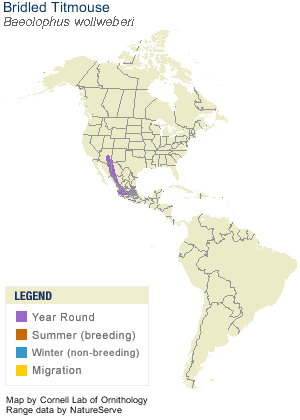
Both of the above have not been recorded in Texas at all.
Only Black-crested, Tufted, and Juniper have been recorded in the state.
The latter is remarkably isolated within the state and the former two hybridize all over their overlap zone. A frustrating topic, to be sure!
So to discuss the ranges of Baeolophus atricristatus (Black-crested), Baeolophus bicolor (Tufted), and Baeolophus ridgwayi (Juniper), let's start with the image below.
The above is a beautiful comparison of North American titmice, their faces and their ranges (though Black-crested does range a bit more NW than they show, making it into the Davis Mountains), via Cornell's Project Feeder Watch page on name changes.
The Guadalupe Mountains of far West Texas does harbor a population of Juniper Titmice (where they are also listed as an irruptive species), but their range in Texas stops there. Period. The rest of Texas is free of Juniper Titmice. Black-crested Titmice do not tend to overlap with Juniper at all, leaving little room for speculation of hybridization. New Mexico birders, unfortunately, must keep dreaming.
This leaves Black-crested Titmice ranging from the mountains in West Texas (but not the Guadalupes - this is why we distrust eBird maps) well into central and South Texas. Frustratingly, there is a large hybrid zone in central Texas along the swath of Tufted Titmouse range. The latter is highly unlikely to end up in West Texas, so they are not our primary focus.
Juniper Titmouse is the contested creature. Thankfully, eBird now has filters for Juniper Titmice in the Trans-Pecos region (but not the Panhandle?), but there are about a dozen reports from Brewster County. None on eBird, interestingly enough, from the Davis Mountains or Jeff Davis county - a gap in what would otherwise bridge the sightings. The reports from Brewster Co., with one exception ("Marathon"), are from Big Bend National Park and mostly in the Chisos. Aside from young Black-crested Titmice in summer that could look a bit confusing, winter reports were perhaps birds that were heard only and not seen? Or enthusiastic individuals who thought the habitat not fit for Black-crested jumped to conclusions? This is all speculation, but apparently so are the reports... and this is a nice summary of why citizen science is what it is. Thankfully the regional editors have changed the Juniper Titmouse status on eBird and any sightings outside of the Guadalupe Mountains will be 'flagged' for review. But until the filters are ironed out, folks hoping to find Juniper Titmice may see what appears to be an isolated year-round population in the Chisos Mountains (via the eBird map) and jump to some interesting conclusions.
From the Texas Bird Breeding Atlas Juniper Titmouse page:
DISTRIBUTION. During the 1987-1992 TBBA field work atlasers found 3 possible and 2 probable breeding records near the Guadalupe Mountains of Trans-Pecos Texas. Nesting was first discovered here in 1973, providing the first breeding record for this state. Reports of this species from other parts of west Texas are probably actually young Black-crested Titmice (B. atricristatus) which acquires its fully black crest as late as its second year after hatching, progressing through gray to dull brown tipped with gray (Oberholser 1974). The species has been reported from the Davis Mountains but breeding has not been documented there (Lockwood and Freeman 2004).
Folks have posted really lovely summaries of why presence/absence 'counting' is slightly ridiculous* and Juniper Titmice are also a good example of that. While we are certainly guilty of listing "X" for a species, even ONE Juniper Titmouse anywhere outside of the Guadalupe Mts is pretty phenomenal. So eBird reports from the park that list "X" or "2" should be scrutinized. Notes, photos and extensive documentation would be appropriate. Ideally, any of the reports would have had some sort of note - heard only, photo'd, or otherwise.
* Fantastic references for counting, via eBird:
Bird Counting 101
Bird Counting 201
Someday we'll have 'compact counting' tips posted as well, but that's more fodder for future posts!
Tuesday, February 21, 2012
Birds hitting your windows?
The American Bird Conservancy has produced a fantastic new product: BirdTape.
Ultimately, windows kill more birds in the US than all other forms of human-related bird deaths (cats, cars, wind turbines, etc), combined. Indeed, it is speculated that many cat kills were stunned from hitting windows first. Many stunned birds who are lucky enough to escape cats still fly away and many die later of internal injuries.
Here's their instructional video:
Be sure to check out the video at the bottom of their collisions page!!
Considering that the Germans have been working on this for years because their sound barriers along highways tend to be glass, it has taken quite a while for the idea to spread. Here are a few pictures from my 2008 trip, starting with a shelter at a train station that was built before the idea caught on - but still has falcon silhouette stickers!

Apologies for the quality of these, they're both taken from inside moving trains. This second design would have been more bird friendly if the stripes were vertical instead of horizontal, but the aesthetic appeal would probably have been decreased. For all practical purposes, though, it will do its job far better than the few stickers on the shelter above!

For a reminder: most buildings have this problem to one degree or another. Here's a kindergarten/elementary school that uses bird stickers and big, bright paper cutouts to prevent bird/people window strikes.

And for grown-ups, here's the airport in Koln: the main building is huge glass panels without any visible sign of stickers or fritting or bird-friendly modifications. Yet the air vents near the parking lot are surrounded by glass panels as well, and they have designs that are about as effective as bird stickers (read: better than nothing, but not by much).

So if you have issues with your windows, don't waste your effort on band-aid fixes like one or two stickers per window - you will have bird prints between the stickers:

Related links:
Problems with Windows
10 Things You Can Do To Reduce Bird vs. Window Collisions
A window into the perils of migration
Seetrail links:
Tis the season; a bird is trying to get into my house
When birds hit windows
Another option: shade structures. A bit more expensive than tape.

Conclusion? My name is Heidi, and I am a window tourist.

(x-posted at Seetrail)
Ultimately, windows kill more birds in the US than all other forms of human-related bird deaths (cats, cars, wind turbines, etc), combined. Indeed, it is speculated that many cat kills were stunned from hitting windows first. Many stunned birds who are lucky enough to escape cats still fly away and many die later of internal injuries.
Here's their instructional video:
Be sure to check out the video at the bottom of their collisions page!!
Considering that the Germans have been working on this for years because their sound barriers along highways tend to be glass, it has taken quite a while for the idea to spread. Here are a few pictures from my 2008 trip, starting with a shelter at a train station that was built before the idea caught on - but still has falcon silhouette stickers!
Apologies for the quality of these, they're both taken from inside moving trains. This second design would have been more bird friendly if the stripes were vertical instead of horizontal, but the aesthetic appeal would probably have been decreased. For all practical purposes, though, it will do its job far better than the few stickers on the shelter above!
For a reminder: most buildings have this problem to one degree or another. Here's a kindergarten/elementary school that uses bird stickers and big, bright paper cutouts to prevent bird/people window strikes.
And for grown-ups, here's the airport in Koln: the main building is huge glass panels without any visible sign of stickers or fritting or bird-friendly modifications. Yet the air vents near the parking lot are surrounded by glass panels as well, and they have designs that are about as effective as bird stickers (read: better than nothing, but not by much).
So if you have issues with your windows, don't waste your effort on band-aid fixes like one or two stickers per window - you will have bird prints between the stickers:
Related links:
Problems with Windows
10 Things You Can Do To Reduce Bird vs. Window Collisions
A window into the perils of migration
Seetrail links:
Tis the season; a bird is trying to get into my house
When birds hit windows
Another option: shade structures. A bit more expensive than tape.
Conclusion? My name is Heidi, and I am a window tourist.
(x-posted at Seetrail)
Saturday, January 21, 2012
Bird hazards: weed cloth
"Weed cloth," as it is commonly known, is an unassuming hazard for birds. It was one that we never particularly paid much attention to, as it is generally used in commercial operations - but this merits another look. Our side blog, SeeTrail has fairly extensive information on window collisions, though many of the 'window' posts merely include strong reflections in windows on our travels. Windows are one hazard that pretty much every household in the US have in common. Weed cloth? Far less so.
On a recent jaunt, a meadowlark under a bird feeder was noticed to be acting abnormally - while they do crouch and hold still for camouflage purposes, not flying away when approached is problematic. Getting closer, the bird began thrashing wildly and was noted to be tangled in the fraying edges of weed cloth. There had been mulch over the cloth, but birds beneath the feeder had scratched it all away in pursuit of fallen seeds.

Gentle handling is critical for birds, so the first step was calming the bird - dropping a hat over it caused it to settle down. In the darkness it was not thrashing, risking leg dislocation and further injury. After removing the meadowlark from under the hat, toes were carefully untangled, the frayed cloth was cut free and the bird was inspected for damage. Thankfully it had not been tangled long and there were no cuts or broken bones noted.

It was released immediately, as it was in good shape. Some good outcomes are recorded from birds that end up with wildlife rehabilitators, but most times the best ones are the ones who never needed to go.

*** It should be noted that the fellow in the photographs has extracted many birds from many mist nets and if anyone finds a bird in a similar situation, a box over the bird to calm it is the best first step. Especially if it is an owl, hawk, heron or other bird that could seriously harm a person, call in someone with experience ASAP - like a wildlife rehabilitator (animal control is better for mammals). As is true of most directories, things change, so call multiple people if the first number doesn't answer. Even if they're not nearby, many rehabbers can give you advice based on the situation you describe to them.
On a recent jaunt, a meadowlark under a bird feeder was noticed to be acting abnormally - while they do crouch and hold still for camouflage purposes, not flying away when approached is problematic. Getting closer, the bird began thrashing wildly and was noted to be tangled in the fraying edges of weed cloth. There had been mulch over the cloth, but birds beneath the feeder had scratched it all away in pursuit of fallen seeds.
Gentle handling is critical for birds, so the first step was calming the bird - dropping a hat over it caused it to settle down. In the darkness it was not thrashing, risking leg dislocation and further injury. After removing the meadowlark from under the hat, toes were carefully untangled, the frayed cloth was cut free and the bird was inspected for damage. Thankfully it had not been tangled long and there were no cuts or broken bones noted.
It was released immediately, as it was in good shape. Some good outcomes are recorded from birds that end up with wildlife rehabilitators, but most times the best ones are the ones who never needed to go.
*** It should be noted that the fellow in the photographs has extracted many birds from many mist nets and if anyone finds a bird in a similar situation, a box over the bird to calm it is the best first step. Especially if it is an owl, hawk, heron or other bird that could seriously harm a person, call in someone with experience ASAP - like a wildlife rehabilitator (animal control is better for mammals). As is true of most directories, things change, so call multiple people if the first number doesn't answer. Even if they're not nearby, many rehabbers can give you advice based on the situation you describe to them.
Tuesday, December 6, 2011
Pochards
They are diving ducks in the Aythya genus.
Heidi came home this morning with a member of this group. It was salvaged on Hwy 385, just southeast of town and the Hwy 90 - Hwy 385 intersection.
Likely powerline collision.

Redhead (Aythya americana), female.
This genus of diving ducks has legs set far back, and quite far apart. If you've ever seen it, you'd know it makes walking on land difficult for them. Many pelagic species are the same way.

However, on water and under it they are in their element.

Diving ducks aren't diving for algae. They generally eat small fish and aquatic invertebrates.

Check out that serrated bill. They have to be able to hold on to their prey item.

Beautiful underwing.
Not really sporting a speculum/wing patch, they do have an extensive gray wing stripe on the upperside of each wing.

Beautiful bird.
We certainly haven't salvaged any ducks out here before. There's a first for everything.
Good find, Heidi.
***
Edit - Q&A session:
For folks curious about the different sorts of dead bird findings, here are some of the commonly used terms and what they mean in the context of our freezer.
Collect/collected - a collection permit means one actively seeks and shoots/traps/kills for the purpose of study. If we 'collect' a bird, it's inadvertent and because our moving vehicle did the job for us - we do brake for birds, but sometimes 'collecting' in that context does happen. It really doesn't count as such, however, because it ends up as... salvage.
Salvage - it's already dead, but we'll do the best we can to make it useful for study. This is how we come upon 99.9% of our dead things. We find them already dead - by car, cat, window, emaciation and power line (in order of frequency for Brewster County so far).
Scavenge - this is what other animals do. A 'scavenger hunt' for people involves finding things intentionally; a scavenger is a creature that happens upon a delicious morsel that is already dead and 'scavenged' is the condition that you'd call a pile of feathers. Not enough left to salvage, generally.
To recap: Shooting a bird for study is collecting. Picking up a bird that was hit by a car is salvage. A pile of feathers below a window indicates that the bird was scavenged.
-heidi
Heidi came home this morning with a member of this group. It was salvaged on Hwy 385, just southeast of town and the Hwy 90 - Hwy 385 intersection.
Likely powerline collision.
Redhead (Aythya americana), female.
This genus of diving ducks has legs set far back, and quite far apart. If you've ever seen it, you'd know it makes walking on land difficult for them. Many pelagic species are the same way.
However, on water and under it they are in their element.
Diving ducks aren't diving for algae. They generally eat small fish and aquatic invertebrates.
Check out that serrated bill. They have to be able to hold on to their prey item.
Beautiful underwing.
Not really sporting a speculum/wing patch, they do have an extensive gray wing stripe on the upperside of each wing.
Beautiful bird.
We certainly haven't salvaged any ducks out here before. There's a first for everything.
Good find, Heidi.
***
Edit - Q&A session:
For folks curious about the different sorts of dead bird findings, here are some of the commonly used terms and what they mean in the context of our freezer.
Collect/collected - a collection permit means one actively seeks and shoots/traps/kills for the purpose of study. If we 'collect' a bird, it's inadvertent and because our moving vehicle did the job for us - we do brake for birds, but sometimes 'collecting' in that context does happen. It really doesn't count as such, however, because it ends up as... salvage.
Salvage - it's already dead, but we'll do the best we can to make it useful for study. This is how we come upon 99.9% of our dead things. We find them already dead - by car, cat, window, emaciation and power line (in order of frequency for Brewster County so far).
Scavenge - this is what other animals do. A 'scavenger hunt' for people involves finding things intentionally; a scavenger is a creature that happens upon a delicious morsel that is already dead and 'scavenged' is the condition that you'd call a pile of feathers. Not enough left to salvage, generally.
To recap: Shooting a bird for study is collecting. Picking up a bird that was hit by a car is salvage. A pile of feathers below a window indicates that the bird was scavenged.
-heidi
Saturday, November 5, 2011
The "why" of window monitoring
Birds hit windows. It's pretty much impossible to overstate the extent of the issue. Pretty much everyone knows that it happens but very few people look beyond face value of the smudge on glass.
This is more eloquent than anything I've seen yet, so please take a look at
Tim O'Connell's piece: A window into the perils of migration. He beautifully outlines the "how" and "why" of dead birds as educational tools, as well as one example of the mind boggling architecture that causes such high mortality rates. Flat-sided buildings are bad enough, but a horseshoe with a 'corridor effect' cluster at one end? Yikes!
On a coincidental note, I'm about half way into a paper on the complexities of North American window collisions - they've been my constant companion since 2003 and I need to get my thoughts out of my head and into writing. Unfortunately it's a rather dry, sciency sort of writing, but I think the discussion will be helpful. It's just terribly difficult to keep citations sorted out since there are about 20 papers that cite each other ad infinitum and the resulting citation loop is frustrating. One paper that I criticize lists my paper in its citations, too, for that matter!
Anyway, here are some lovelies - Tennessee Warblers - from Principia, circa 2004-2005 (a tiny fraction of the actual species diversity and even fewer of the overall body count.)

External link: dead bird album
This is also cross-posted over at SeeTrail.
This is more eloquent than anything I've seen yet, so please take a look at
Tim O'Connell's piece: A window into the perils of migration. He beautifully outlines the "how" and "why" of dead birds as educational tools, as well as one example of the mind boggling architecture that causes such high mortality rates. Flat-sided buildings are bad enough, but a horseshoe with a 'corridor effect' cluster at one end? Yikes!
On a coincidental note, I'm about half way into a paper on the complexities of North American window collisions - they've been my constant companion since 2003 and I need to get my thoughts out of my head and into writing. Unfortunately it's a rather dry, sciency sort of writing, but I think the discussion will be helpful. It's just terribly difficult to keep citations sorted out since there are about 20 papers that cite each other ad infinitum and the resulting citation loop is frustrating. One paper that I criticize lists my paper in its citations, too, for that matter!
Anyway, here are some lovelies - Tennessee Warblers - from Principia, circa 2004-2005 (a tiny fraction of the actual species diversity and even fewer of the overall body count.)
External link: dead bird album
This is also cross-posted over at SeeTrail.
Saturday, October 15, 2011
Rio Grande Valley Birding Festival; Join Us!
From November 9th until the 13th, the Rio Grande Valley Birding Festival in Harlingen, Texas, will be hopping with birders, birds and... us? It's short notice, yes, but all day on the 11th, 12th and 13th, you'll find us tucked away at a booth somewhere - trade show details here. The trade show is free to attend and open to the public, so it'll be a great chance for any of our south Texas readers to pop in and say hi! We'll be representing the Gage Hotel, but more appropriately, we'll be promoting the Gage Gardens.
All things considered, Marathon is quite centrally located in terms of reasonable birding day trips: the attractions page lists Big Bend National Park, the Chihuahuan Desert Research Institute, Balmorhea State Park, McDonald Observatory, Museum of the Big Bend, Marfa Lights, Terlingua Ghost Town... in addition to those, several galleries, museums, restaurants and desert/river adventure companies are listed. Davis Mountains State Park and all things Fort Davis should also be on there!
Another random perk for attendees: y'all will get to see our shiny new business card! We'll be keeping the horned lizard business card, but also introducing a new picture (and updated contact information, which would be helpful).

(image yoinked from 10,000 birds.com)
All things considered, Marathon is quite centrally located in terms of reasonable birding day trips: the attractions page lists Big Bend National Park, the Chihuahuan Desert Research Institute, Balmorhea State Park, McDonald Observatory, Museum of the Big Bend, Marfa Lights, Terlingua Ghost Town... in addition to those, several galleries, museums, restaurants and desert/river adventure companies are listed. Davis Mountains State Park and all things Fort Davis should also be on there!
Another random perk for attendees: y'all will get to see our shiny new business card! We'll be keeping the horned lizard business card, but also introducing a new picture (and updated contact information, which would be helpful).
(image yoinked from 10,000 birds.com)
Tuesday, April 5, 2011
Scarlet Tanagers and Post Park
Q & A time:
E-bird flagged my 2 Scarlet Tanagers at Post Park, but I saw two large, bright red birds with black wings.
For some reason there seems to be a lot of confusion about red birds at Post Park.
There are many male Vermilion Flycatchers on a normal day at the Post (though they tend to leave north Brewster Co. in the winter). Scarlet Tanagers - at any time of year - are VERY unlikely. Back color and presence/absence of an eye line should be noted, as well as behavior. Vermilions tend to like exposed perches, low branches, and are generally very active. Scarlet Tanagers tend to be secretive in their preference of upper/inner canopy levels and do not tend to be acrobatic in behavior.

Adult male Vermilion Flycatcher, Post Park / Fort Pena Colorado, April 2011.
Heidi Trudell
Apparently a lot of folks who are not familiar with the male Vermilion Flycatcher see the red/black and write it off as an unmistakable Scarlet Tanager. A quick view in flight leaves many questions unanswered, but every bird is worth double checking in a field guide just to be sure; all Scarlet Tanager reports from Post Park should be backed with photo documentation. Their normal range is well east of Brewster Co.
Here's the range for Scarlet Tanager, via allaboutbirds.org:

Here's Vermilion Flycatcher, via whatbird.com:

For more information about both species - ranges, plumages, vocalizations, etc:
Vermilion Flycatcher ID page from allaboutbirds.org
Scarlet Tanager ID page from allaboutbirds.org
A few other troublesome reddish birds at Post Park:
Northern Cardinals and Pyrrhuloxias at the Post. Always double check beak color.
Say's Phoebe and female Vermilion Flycatchers; head color and size are important!
E-bird flagged my 2 Scarlet Tanagers at Post Park, but I saw two large, bright red birds with black wings.
For some reason there seems to be a lot of confusion about red birds at Post Park.
There are many male Vermilion Flycatchers on a normal day at the Post (though they tend to leave north Brewster Co. in the winter). Scarlet Tanagers - at any time of year - are VERY unlikely. Back color and presence/absence of an eye line should be noted, as well as behavior. Vermilions tend to like exposed perches, low branches, and are generally very active. Scarlet Tanagers tend to be secretive in their preference of upper/inner canopy levels and do not tend to be acrobatic in behavior.

Adult male Vermilion Flycatcher, Post Park / Fort Pena Colorado, April 2011.
Heidi Trudell
Apparently a lot of folks who are not familiar with the male Vermilion Flycatcher see the red/black and write it off as an unmistakable Scarlet Tanager. A quick view in flight leaves many questions unanswered, but every bird is worth double checking in a field guide just to be sure; all Scarlet Tanager reports from Post Park should be backed with photo documentation. Their normal range is well east of Brewster Co.
Here's the range for Scarlet Tanager, via allaboutbirds.org:
Here's Vermilion Flycatcher, via whatbird.com:
For more information about both species - ranges, plumages, vocalizations, etc:
Vermilion Flycatcher ID page from allaboutbirds.org
Scarlet Tanager ID page from allaboutbirds.org
A few other troublesome reddish birds at Post Park:
Northern Cardinals and Pyrrhuloxias at the Post. Always double check beak color.
Say's Phoebe and female Vermilion Flycatchers; head color and size are important!
Wednesday, February 16, 2011
Wildlife Weekends - Marathon & Post Park
Please note that dates/times may change but we will do our best to post accurate and updated information as soon as we know! All activities are free, though donations are accepted.
Sunday Morning Bird Walks at Post Park:
Join us on Sunday mornings at Post Park (Ft. Pena Colorado) at 8:30 am (summer) or 9 am (winter) for a free, guided bird/butterfly/nature walk.
Unfortunately, due to work conflicts, we will be suspending the Sunday morning bird walks indefinitely, as of 9 July, 2012. Please contact us regarding availability during the week.
Click here to download the birds of the Trans-Pecos checklist pdf
Friday Night [Black]Lights:
On Friday nights from March/April through October, we invite all interested to join in blacklighting for moths around town. This is a fantastic region with diverse bugs - amateurs to experts are very much encouraged to join and share your knowledge and enthusiasm! We may, on occasion, blacklight at Post Park as well as "The Double Bacon" - times and locations TBA, please call or e-mail for information! ( h.trudell at bigbendnature.com or 617.823.4862 )
* With advance notice, groups can be accommodated if our schedules allow!
Sunday Morning Bird Walks at Post Park:
Unfortunately, due to work conflicts, we will be suspending the Sunday morning bird walks indefinitely, as of 9 July, 2012. Please contact us regarding availability during the week.
Click here to download the birds of the Trans-Pecos checklist pdf
Friday Night [Black]Lights:
On Friday nights from March/April through October, we invite all interested to join in blacklighting for moths around town. This is a fantastic region with diverse bugs - amateurs to experts are very much encouraged to join and share your knowledge and enthusiasm! We may, on occasion, blacklight at Post Park as well as "The Double Bacon" - times and locations TBA, please call or e-mail for information! ( h.trudell at bigbendnature.com or 617.823.4862 )
* With advance notice, groups can be accommodated if our schedules allow!
Saturday, January 15, 2011
Aplomado Falcons in west Texas
Our occasional updates have been a bit slow lately, so here's our personal update in a nutshell: Christmas Bird Counts, having family in town, playing with plants and generally working hard. Also fighting the battle to get out of bed on ten degree mornings. Thankfully, that cold snap has ended!
Otherwise I was hoping to indulge in a timely Q&A session. This is part of an e-mail that we received recently from a friend who was returning from a birding trip to the Rio Grande Valley and was curious about the status of Aplomado Falcons out here:
While my first Aplomado Falcon was seen on the illustrious "road to the Brownsville dump," some people have been lucky enough to see them in/around Brewster County. But luck does seem to be the most appropriate word for it. The Peregrine Fund has been working on Aplomado Falcon restoration/reintroduction in west Texas for about 15 years. In that time, the south Texas population has done remarkably well. Out here? Not so much.
Recent sightings:
18 May, 2010 - Terlingua Ranch (unknown individual; in flight)
...that's it for us, other than one late September sighting that was also of a bird in flight (while driving 75 mph) a few miles west of Marathon. A local birder reported one in late December near Black Gap Wildlife Management Area. Certainly, there were single-digit sightings from Highway 90 during the release (C2 being the individual when we were able to read the band), but for the most part it's a challenge to find the proverbial needle in a haystack.

Young Aplomado Falcon; either Green 93, Red H7, Red 16, or Green 95. September 10, 2010. Ten miles east of Marathon, TX. Photo by Heidi Trudell
For seekers of Aplomado Falcons, the challenge is this: few falcons, restricted land access. By contrast, Old Port Isabel Road (NE Brownsville) is the hub of Texas breeding activity for the birds; there were 8 nesting pairs at last count (per Brian Mutch, of The Peregrine Fund).
For Aplomado Falcons, the challenge out here is multifaceted and not entirely well understood. The Peregrine Fund intends to further research the west Texas populations in the coming years to investigate why that may be - Great Horned Owls are the primary threat to young falcons during the release process (Matagorda Island and other owl-less islands have remarkably high success rates), but they are not the determining factor in older birds. As with most species, mortality rates are quite high in the first year, quite a bit lower in the second, and nearly negligible beyond the third year of life.
To appreciate the nomadic tendency that Aplomados exhibit, consider this: when 'hack' sites were within 50 miles of each other, birds from both sites would show up to feed at each. Sierra Blanca, Valentine and Marathon have been areas with recent releases - they're far enough apart that the birds won't get mixed up at different sites. [To my understanding, this is simply to cut down on observer errors due to similar band numbers.]
So to address each question simply:
Q: Have any have Aplomado Falcons been sighted here recently?
A: Yes. But they are few and far between
Q: Have any of your banded falcons been spotted elsewhere?
A: Not yet that we know of; always hoping!
Q: What is the success rate of the releases?
A: Lower than hoped for the region - of 19 birds we released, 9 made it to the "61 day" mark, but 8 were pretty much predated upon release (this seems to be the general consensus). This is about average, it seems, but averages don't usually include immediate predation - 'our' site will likely not be used again due to the predation issue.
Q: Do you know how many times the falcons have been released in your area?
A: Not exactly. The site we worked had been used for releases at least 3 or 4 times in the preceding 10 years. There are generally at least two release sites in west Texas each year (for reference, our location was the eastern-most of the western sites and our late-season crew supervisors were based in Deming, NM) and each location ends up with 10-20 birds to be released.
Thanks for bearing with me for a super-long post! Feel free to post more questions in the post comments and we'll do our best to answer them - or elaborate more on topics already mentioned.
For further reading: SeeTrail tag, Aplomado Falcons
Otherwise I was hoping to indulge in a timely Q&A session. This is part of an e-mail that we received recently from a friend who was returning from a birding trip to the Rio Grande Valley and was curious about the status of Aplomado Falcons out here:
I know that you & Matt released some young falcons and after reading through your blog, I was wondering if any have been sighted recently in your area or have any of your banded falcons been spotted elsewhere? I am curious about the success rate of the releases - do you know how many times the falcons have been released in your area?
-L.B.
While my first Aplomado Falcon was seen on the illustrious "road to the Brownsville dump," some people have been lucky enough to see them in/around Brewster County. But luck does seem to be the most appropriate word for it. The Peregrine Fund has been working on Aplomado Falcon restoration/reintroduction in west Texas for about 15 years. In that time, the south Texas population has done remarkably well. Out here? Not so much.
Recent sightings:
18 May, 2010 - Terlingua Ranch (unknown individual; in flight)
...that's it for us, other than one late September sighting that was also of a bird in flight (while driving 75 mph) a few miles west of Marathon. A local birder reported one in late December near Black Gap Wildlife Management Area. Certainly, there were single-digit sightings from Highway 90 during the release (C2 being the individual when we were able to read the band), but for the most part it's a challenge to find the proverbial needle in a haystack.

Young Aplomado Falcon; either Green 93, Red H7, Red 16, or Green 95. September 10, 2010. Ten miles east of Marathon, TX. Photo by Heidi Trudell
For seekers of Aplomado Falcons, the challenge is this: few falcons, restricted land access. By contrast, Old Port Isabel Road (NE Brownsville) is the hub of Texas breeding activity for the birds; there were 8 nesting pairs at last count (per Brian Mutch, of The Peregrine Fund).
For Aplomado Falcons, the challenge out here is multifaceted and not entirely well understood. The Peregrine Fund intends to further research the west Texas populations in the coming years to investigate why that may be - Great Horned Owls are the primary threat to young falcons during the release process (Matagorda Island and other owl-less islands have remarkably high success rates), but they are not the determining factor in older birds. As with most species, mortality rates are quite high in the first year, quite a bit lower in the second, and nearly negligible beyond the third year of life.
To appreciate the nomadic tendency that Aplomados exhibit, consider this: when 'hack' sites were within 50 miles of each other, birds from both sites would show up to feed at each. Sierra Blanca, Valentine and Marathon have been areas with recent releases - they're far enough apart that the birds won't get mixed up at different sites. [To my understanding, this is simply to cut down on observer errors due to similar band numbers.]
So to address each question simply:
Q: Have any have Aplomado Falcons been sighted here recently?
A: Yes. But they are few and far between
Q: Have any of your banded falcons been spotted elsewhere?
A: Not yet that we know of; always hoping!
Q: What is the success rate of the releases?
A: Lower than hoped for the region - of 19 birds we released, 9 made it to the "61 day" mark, but 8 were pretty much predated upon release (this seems to be the general consensus). This is about average, it seems, but averages don't usually include immediate predation - 'our' site will likely not be used again due to the predation issue.
Q: Do you know how many times the falcons have been released in your area?
A: Not exactly. The site we worked had been used for releases at least 3 or 4 times in the preceding 10 years. There are generally at least two release sites in west Texas each year (for reference, our location was the eastern-most of the western sites and our late-season crew supervisors were based in Deming, NM) and each location ends up with 10-20 birds to be released.
Thanks for bearing with me for a super-long post! Feel free to post more questions in the post comments and we'll do our best to answer them - or elaborate more on topics already mentioned.
For further reading: SeeTrail tag, Aplomado Falcons
Monday, December 13, 2010
Schrödinger's Quail
This was originally posted over at SeeTrail; it is backdated here. It was also posted here, in a cleaned-up, more-formal version as Mearns Quail = Montezuma Quail.
This morning at about 9:30 I got a phone call from a dear friend and fellow birder. He reported a deceased Montezuma Quail at the Lawrence E. Wood picnic area in the Davis Mountains. I was *thrilled* because I thought that meant that he had picked it up for me. Alas. He was already in Balmorhea and the bird was still on the side of the road!
In a hasty scramble, Matt and I attempted to notify birders in Alpine and Fort Davis and anyone who might possibly still be in the area after chasing the Tufted Flycatcher - and we came up empty handed. We knew that the bird was dead. But was it still there? Had it been hit again? What state was it in; smashed or still fresh? We summoned the powers of Sul Ross and The Nature Conservancy in the form of voice mail, e-mail and feeble telepathy. By 11:30 I was able to sneak away from work; we'd not been able to check e-mail since our initial plea, but it was worth the risk to discover whether or not 'Schrödinger's Quail' was still on the side of the road for me.
Best case scenario:
Dead Montezuma Quail would be in the shade on the side of the road.
Plausible Situation A:
Dead Montezuma Quail would be picked up by someone else.
Plausible Situation B:
Dead, smashed Montezuma Quail would be on the side of the road.
Plausible Situation C:
Dead Montezuma Quail would be unable to be located.
Clearly with A & C, there's room for interpretation. A phone or e-mail not to be received for a long time, a scavenger traipsing off with a prize...
So for the longest 90 minute drive, the Montezuma Quail was in a simultaneous state of being there and not-being-there; I just needed to open the proverbial box and look.
1: It is there!

2: The facial pattern indicates that the bird is male.

3: The poofy crown concealed a few pin feathers.

4: Disney's version of "Sleeping Beauty" got nothin' on this guy.

5: Big, scratchy, kicky claws. All the better to dig at roots with.

6: I spy something molting. The gap in primary feathers has a new one growing in.

Post to be elaborated upon once we've walked the dog and had dinner and... you get the idea =)
FAQ #1
Q: Aren't you worried about catching something?
A: No. As with windows and wind turbines, cars tend to hit birds that are healthy enough to cross roads. If the bird was a carrier of [West Nile, Avian Influenza, etc] I'd still probably have to lick it (for fecal/saliva contamination) and that's just not how I operate.
Edit: the slightly more stuffy version of this post is over at that other blog that steals all of our attention these days.
This morning at about 9:30 I got a phone call from a dear friend and fellow birder. He reported a deceased Montezuma Quail at the Lawrence E. Wood picnic area in the Davis Mountains. I was *thrilled* because I thought that meant that he had picked it up for me. Alas. He was already in Balmorhea and the bird was still on the side of the road!
In a hasty scramble, Matt and I attempted to notify birders in Alpine and Fort Davis and anyone who might possibly still be in the area after chasing the Tufted Flycatcher - and we came up empty handed. We knew that the bird was dead. But was it still there? Had it been hit again? What state was it in; smashed or still fresh? We summoned the powers of Sul Ross and The Nature Conservancy in the form of voice mail, e-mail and feeble telepathy. By 11:30 I was able to sneak away from work; we'd not been able to check e-mail since our initial plea, but it was worth the risk to discover whether or not 'Schrödinger's Quail' was still on the side of the road for me.
Best case scenario:
Dead Montezuma Quail would be in the shade on the side of the road.
Plausible Situation A:
Dead Montezuma Quail would be picked up by someone else.
Plausible Situation B:
Dead, smashed Montezuma Quail would be on the side of the road.
Plausible Situation C:
Dead Montezuma Quail would be unable to be located.
Clearly with A & C, there's room for interpretation. A phone or e-mail not to be received for a long time, a scavenger traipsing off with a prize...
So for the longest 90 minute drive, the Montezuma Quail was in a simultaneous state of being there and not-being-there; I just needed to open the proverbial box and look.
1: It is there!

2: The facial pattern indicates that the bird is male.

3: The poofy crown concealed a few pin feathers.

4: Disney's version of "Sleeping Beauty" got nothin' on this guy.

5: Big, scratchy, kicky claws. All the better to dig at roots with.

6: I spy something molting. The gap in primary feathers has a new one growing in.

Post to be elaborated upon once we've walked the dog and had dinner and... you get the idea =)
FAQ #1
Q: Aren't you worried about catching something?
A: No. As with windows and wind turbines, cars tend to hit birds that are healthy enough to cross roads. If the bird was a carrier of [West Nile, Avian Influenza, etc] I'd still probably have to lick it (for fecal/saliva contamination) and that's just not how I operate.
Edit: the slightly more stuffy version of this post is over at that other blog that steals all of our attention these days.
Subscribe to:
Posts (Atom)