The following content was kindly approved for sharing by Stu Wilson, intrepid Breeding Bird Survey adventurer currently living in FL - he's done WTX BBS routes for many years and sent his end of route summary. This is shared with his permission, and with our gratitude for his efforts!
* Post Park was mistakenly listed as being south of Marfa, in Presidio County: it has been corrected to being south of Marathon, in Brewster County. Links were modified to be blog friendly.
***
All-
I've put together a little wrap-up for my 4-11May2015 central Trans-Pecos BBS trip. Besides my three current BBS routes, I made a number of "general interest birding" stops, many of which I entered into eBird. The area continues to suffer from the effects of drought as well as the freeze and fire of 2011, but there were signs of recovery, e.g. good numbers of Scaled Quail and Greater Roadrunner. In general, neotropical migrants were in short supply anywhere I went.
El Paso Memorial Park (FWTX 9) 4May2015
One of the best opportunities to find migrants within the El Paso city limits is this urban park (El Paso County). However, I found very few- a Western Wood-Pewee, an Audubon's Yellow-rump, and several Wilson's Warbler- amongst 20 species total. eBird checklist here
McNary Reservoir 5May2015
Auduboners generally have permission to visit this water body located about 80 miles east of El Paso in Hudspeth County. I tallied 34 species in an hour including both Western and Clark's Grebes, as well as a pair of Red-breasted Mergansers, possibly a new May record for the area. eBird checklist here
Marathon- Ft Pena Colorado Pk (The Post) (FWTX 28) 5May2015
This popular birding stop 5 miles south of Marathon in Brewster County was flush with water and yielded 26 species, but no rarities and just a couple of migrants. eBird checklist here
Alamito Creek Preserve 6May2015
This was my fourth visit to this cottonwood-lined riparian desert strip 35 miles south of Marfa in Presidio County. I started out the walk with Robert Potts, president of property owner Dixon Water Foundation, as well as Jay Pruett from Tulsa and Bob Ayres from Austin. Those three had to turn back mid-morning to tend to some business, but I walked the full 3.5-mile segment, and return, picking up 40 spp. Although there were some impressive numbers of individuals (52 House Finch, 60 Mourning Dove, 58 Northern Mockingbird, 42 Orchard Oriole, 45 Summer Tanager, and 46 Vermilion Flycatcher), and some good raptor activity (2 nesting pairs of Zone-tailed and 1 pair of Swainson's Hawk), migrants were few... only two species of warbler (Audubon's Yellow-rumped and Wilson's). eBird checklist here
Coyanda Draw BBS (Pecos Co 35 mi WSW of Ft Stockton) 7May2015 Habitat: dry and desolate Chihuahuan Desert scrub
I had to contend with only 2 vehicles the entire route! Veteran BBSers know what a luxury that is. The route produced 25 spp with Northern Mockingbird taking home the bacon at 61 and Scaled Quail trailing with 50.
* The Barn Owls at Stop 1 have apparently been evicted by a pair of Great Horned Owls
* 4 Lesser Nighthawks was very low
* Cassin's and Black-throated Sparrow made nice showings with 28 each
* Cactus Wren (avg 20+) has not rebounded on this route as I had only 2
Balmorhea- Sandia Wetlands (FWTX 20A) 7May2015
I had not previously visited this small facility east of Balmorhea in Reeves County, but was glad I did. I found 25 spp highlighted by Cinnamon Teal, Black-necked Stilt, American Avocet, Baird's Sandpiper, Long-billed Dowitcher, Wilson's Phalarope, Scissor-tailed Flycatcher, Bank Swallow, Grasshopper Sparrow, and Yellow-headed Blackbird. eBird checklist here
Balmorhea Lake - Sandia Wetlands (FWTX 20) 7May2015
I did a loop around the lake, but it was now late afternoon and there just wasn't much happening. I noted about 16 spp, including both Aechmophorus grebes and a couple late Eared Grebes. A lone Ruddy Duck also seemed late.
Toyahvale BBS (Jeff Davis Co between Balmorhea and Ft Davis) 8May2015 Habitat: Davis Mtn foothills
This route was especially fire-ravaged in 2011. I turned up 32 spp with usual champ Northern Mockingbird taking top honors with 55 just overcoming a strong showing by resurging Scaled Quail at 50.
* The Elf Owl pair, present the last two years, could not be found
* Seven (7) Greater Roadrunner may be record for me for any route
* Twenty (20) Black-throated Sparrow was a strong showing
* No evidence of Cactus Wren recovery on this route (avg 16) as I had only 4
* 3 Painted Bunting and 1 Vermilion Flycatcher added some color to things
Bear Mountain BBS (Jeff Davis Co on the NW flanks of Davis Mountains) 9May2015 Habitat: Davis Mtn foothills (desert transitioning to oak/juniper)
This route has become my favorite for reasons I can't quite pinpoint. Only encountering five (5) vehicles on a route with a nicely paved road certainly helps. I tallied 34 spp with Northern Mockingbird achieving top dog at 27 individuals withstanding a strong challenge from Cactus Wren with 24. The Cactus Wren total is right at the historic average and suggests, on this route at least, the species is recovering.
* Cassin's Sparrow (avg 16) curiously absent from this route
* Six (6) Greater Roadrunner might be a record except for Toyahvale above
* Eighteen (18) Canyon Towhees might be a record for me for any route
* A Yellow-breasted Chat lustily singing in the wide open was a nice surprise
Madera Canyon Trail (FWTX 25) 9May2015
This 2.5-mile loop trail starts (and ends) at the south end of the Lawrence E Wood Picnic Area on TX 118 in Jeff Davis County. Most of the juniper trees are dead or dying lending a desolate air, but I nonetheless managed 17 spp including a rampaging young Cooper's Hawk and a Hepatic Tanager pair where the female was doing the singing. eBird checklist here
Big Bend NP- Chisos Basin 10May2015
I had run into some birders from Maryland at Davis Mountains SP who had just been to BBNP (Brewster County) and told me of the rarities lurking there: Short-tailed Hawk, Northern Pygmy-Owl, Flame-colored Tanager, and Evening Grosbeak. Given my limited time, I decided the latter three were out of reach, but I was on point for the STHA, which I thought I understood them to say was being seen (a dark morph and a light morph??) in the Chisos Basin from the lodge area. It didn't fill me with confidence when each of the five (5) rangers I quizzed indicated they were unaware of any rare hawks, and in the end I failed to turn one up. In the course of things, I did a long mid-day hike through the campgrounds, down to the sewage treatment plant, and out and back on the Window Trail, tallying about 17 species, but nothing unexpected. That evening I hiked up the Pinnacles Trail about a half-mile above the cottages and did a 7-9pm sentry duty listening for Mexican Whip-poor-will, but heard not a one. The mountain lion signs say "don't hike alone" and "don't hike at night" and I must confess this weighed on me as the day's light grew dim. My overnight accommodation was a room in the Emory Peak Lodge area but, despite leaving my windows open all night and doing a couple of short local hikes, I heard no owl nor nightjar at all.
Big Bend NP- Cottonwood Campground (FWTX 40) 11May2015
I got up early for the 38-mi drive to Cottonwood CG, arriving just after sunrise, and was promptly greeted by an Elf Owl. Other nuggets amongst 27 spp found were a Cassin's Vireo, a MacGillivray's Warbler, and several singing Yellow-breasted Chats. The prize, however, and the Bird of the Trip for me was a singing male Lucy's Warbler which I found just across the entrance road from the Amphitheater... my first new Texas bird (#489) since a Canada Warbler at Hornsby Bend in Austin on 19Sep2011. eBird checklist here
Out,
Stu

Blogging from Marathon, TX about birding, butterflies, moths and more. Exploring the gems of Brewster County, Post Park, Big Bend National Park and the surrounding region. Bird watching: Big Bend and beyond!
Showing posts with label Post Park. Show all posts
Showing posts with label Post Park. Show all posts
Thursday, May 14, 2015


Tuesday, May 27, 2014
Pipevine at Post Park
Post Road and Post Park were quite birdy (hat-tip to Bill Sain for another excellent adventure), but the highlight was simply being outside on a fantastic day. Admittedly, I did sigh that there were no leps around and a Queen, Pipevine Swallowtail, and a mystery skipper decided to cooperate. Not that any of them are earth shattering, but it seems to have been a quiet spring for butterflies, perhaps due to lack of moisture.
Bird list for Post Road here and bird list for Post Park here.
 |
| Pipevine Swallowtail, Battus philenor. Post Park, Marathon/Brewster Co, TX. 27 May 2014. |
Bird list for Post Road here and bird list for Post Park here.
Tuesday, March 18, 2014
Sketchy winter sparrows
On Sunday, March 16, it was miserably cold, windy, overcast, and challenging to bird in. A lovely couple from Arizona braved the elements and Post Park did not disappoint, so it was after 11 am when we tried our last stop of the morning at the Gage Gardens. Meadowlarks were blown past us and what few birds were around certainly did not cooperate much... except for a buffy-faced, large sparrow. Harris's Sparrow is really not expected out here at all. It had dark black smudging around the beak and I wondered if it may have been the same bird as two winters prior (spoiler: nope). Having no camera on hand at the time, I knew I would have to return to try for photos.
Guess my next task is to go back and try to refind the bird from Sunday now!
Edit:
Here's a lousy pic of the field sketch of the second bird, after the first round of really bad photos.

I would like to thank my art teacher in high school for drawing ON students' work to indicate what she wanted them to do. That dissuaded me from pursuing art classes further. Otherwise, this English/History/Biology/perpetual student prefers scribbles when snapshots aren't available.
My glorious sketch of Sunday's Harris's Sparrow:

With local birder, Bill Sain, Tuesday morning (the 18th), two hours were spent canvassing the Gardens. Only shortly before we left did Bill spot rustling behind a yucca that proved to be White-crowned Sparrows with a khaki counterpart. But it was not 'my' bird from Sunday - far more extensive black smudges covered the chin, throat, and crown! Naturally, we were unable to relocate the second individual. This individual is far more similar to the bird from two winters prior...
Here's a bad photo of a bad photo, but diagnostic:


With local birder, Bill Sain, Tuesday morning (the 18th), two hours were spent canvassing the Gardens. Only shortly before we left did Bill spot rustling behind a yucca that proved to be White-crowned Sparrows with a khaki counterpart. But it was not 'my' bird from Sunday - far more extensive black smudges covered the chin, throat, and crown! Naturally, we were unable to relocate the second individual. This individual is far more similar to the bird from two winters prior...
Here's a bad photo of a bad photo, but diagnostic:

Guess my next task is to go back and try to refind the bird from Sunday now!
Edit:
Here's a lousy pic of the field sketch of the second bird, after the first round of really bad photos.

I would like to thank my art teacher in high school for drawing ON students' work to indicate what she wanted them to do. That dissuaded me from pursuing art classes further. Otherwise, this English/History/Biology/perpetual student prefers scribbles when snapshots aren't available.
Monday, February 17, 2014
Small Checkered Skipper
...and we thought spring was going to wait until March or April... guess we need to bust out the black lights because things really ARE moving! Apologies for the incredibly low photo quality here; this was a VERY fresh Small Checkered Skipper (Pyrgus scriptura) taken at the ponds SW of Marathon yesterday (16 Feb 2014), digital zoom makes it look oddly, unfortunately blocky.
I recall Small Checkered Skippers being much smaller than this individual seemed (more like Western Pygmy Blues than Common/White Checkered Skippers), and later in the morning we did see a Common/White Checkered Skipper at Post Park - and it really did seem about the same size. Confusing, especially since many early flying leps are smaller than their later-season counterparts.
That said, Post Park and the water crossings on Post Road were FILLED with Mourning Cloaks. Wonderful early fliers, and able to stay aloft in the breeze. Post Road also had a gaggle of pronghorn antelope; they have been absent for some time.
 |
| Small Checkered Skipper (Pyrgus scriptura), 16 February 2014, Brewster Co, TX |
That said, Post Park and the water crossings on Post Road were FILLED with Mourning Cloaks. Wonderful early fliers, and able to stay aloft in the breeze. Post Road also had a gaggle of pronghorn antelope; they have been absent for some time.
Thursday, September 19, 2013
A Killdeer that pales in comparison
Driving back from Post Park.
One roadrunner, two roadrunners....
Slow down to scan the trough - there was nothing there on the way down - is that a really pale Eurasian Collared-Dove? It's not unexpected, but it just doesn't seem right.

Far left side of the water on the ground - it has a pretty large head for a dove though.

With the power of a not-quite-point-and-shoot and some 8x42s...
Leucistic Killdeer. Melanism is extremely dark pigmentation, leucistic creatures are just shy of albinism - and this is a decent example. Well, if the photo were any better, it would be!
For more reading on leucism and melanism and albinism, check out the Sibley blog's excellent discussion of pigment variability! Also, wow. Lots of leucism.
* Apologies, this post was schedule for the 19th but didn't actually get published until the 24th! Not quite sure what was going on there, but blogger has been acting up lately.
One roadrunner, two roadrunners....
Slow down to scan the trough - there was nothing there on the way down - is that a really pale Eurasian Collared-Dove? It's not unexpected, but it just doesn't seem right.

Far left side of the water on the ground - it has a pretty large head for a dove though.

With the power of a not-quite-point-and-shoot and some 8x42s...
 |
| Leucistic Killdeer (Charadrius vociferus) on Post Road, Marathon, TX 14 Sept. 2013 - photo by Heidi Trudell |
Leucistic Killdeer. Melanism is extremely dark pigmentation, leucistic creatures are just shy of albinism - and this is a decent example. Well, if the photo were any better, it would be!
For more reading on leucism and melanism and albinism, check out the Sibley blog's excellent discussion of pigment variability! Also, wow. Lots of leucism.
* Apologies, this post was schedule for the 19th but didn't actually get published until the 24th! Not quite sure what was going on there, but blogger has been acting up lately.
Friday, August 23, 2013
Post Park, in photos
Just focusing on the water, not the picnic tables, facilities, etc. filing for future reference.


Thursday, June 20, 2013
Tricolored Heron, Post Park
This morning, after kicking up some interesting waterfowl* at the ponds SW of town, Matt and I headed over to Post Park. I quickly lost myself in documenting some moths** that turned up at the light in the little shelter at the corner of the dance 'slab' and Matt promptly found a Tricolored Heron! I was able to get a few poorly lit shots of the 'trike' before we left it.
Tricolored Heron, Post Park, Brewster Co. 20 June 2013 -


* first = streaky, female-looking Gadwall... with black rump. So, male in not-quite-eclipse?
* second = male Redhead that had a very dark bill - nonbreeding, very distinctive
** likely our latest ever Apotolype brevicrista
Tricolored Heron, Post Park, Brewster Co. 20 June 2013 -


* first = streaky, female-looking Gadwall... with black rump. So, male in not-quite-eclipse?
* second = male Redhead that had a very dark bill - nonbreeding, very distinctive
** likely our latest ever Apotolype brevicrista
 |
| Apotolype brevicrista - usually a visitor in March and early April! |
Sunday, June 2, 2013
BBNP and Flame-colored post
Flame-colored Tanager update and Big Bend National Park trip summary on Cameron Carver's blog post over at The Painted Bunny. We owe him a Hooded Oriole for such a great post!
(all tags here reflect the content of his post)
Matt's write-up from a few days later is here.
(all tags here reflect the content of his post)
Matt's write-up from a few days later is here.
Thursday, April 25, 2013
on the move
Everything is on the move; Pectoral Sandpipers and Rusty Blackbirds and Pronghorn Antelope, oh my! People, too. So in our posting absence, please accept this offering of other wildlife on the move.
 |
| Bees swarming a cottonwood at Post Park, 17 April 2013 |
 |
| Yellow-headed Blackbirds near the Double Bacon Ranch, 21 April 2013 |
 |
| Bullsnake crossing Post Road, 17 April 2013 |
 |
| Bullsnake crossing Post Road, 17 April 2013 |
 |
| Wilson's Phalaropes at the SW ponds in Marathon, 17 April 2013 |
 |
| Wilson's Phalaropes at the SW ponds in Marathon, 17 April 2013 |
 |
| Wilson's Phalaropes at the SW ponds in Marathon, 17 April 2013 |
 |
| Wilson's Phalaropes at the SW ponds in Marathon, 17 April 2013 |
Saturday, April 20, 2013
Marathon 'patch' news
Starting with a butterfly update from the south side of town...
1 Common Streaky-skipper (Celotes nessus)
Monarchs are still trickling through in single digits along with Checkered Whites; there's so much birding to be done that the butterflies have mostly been incidental!
This week's birding along Post Road and at Post Park (* denotes new arrivals):
Scaled Quail (Callipepla squamata)
Wild Turkey (Meleagris gallopavo)
Pied-billed Grebe (Podilymbus podiceps)*
Turkey Vulture (Cathartes aura)
Cooper's Hawk (Accipiter cooperii)
American Coot (Fulica americana)
Killdeer (Charadrius vociferus)
Eurasian Collared-Dove (Streptopelia decaocto)
White-winged Dove (Zenaida asiatica)
Mourning Dove (Zenaida macroura)
Black-chinned Hummingbird (Archilochus alexandri)
Golden-fronted Woodpecker (Melanerpes aurifrons)
Ladder-backed Woodpecker (Picoides scalaris)
Vermilion Flycatcher (Pyrocephalus rubinus)
Ash-throated Flycatcher (Myiarchus cinerascens)
Western Kingbird (Tyrannus verticalis)
Bell's Vireo (Vireo bellii)
Cassin's Vireo (Vireo cassinii)*
Northern Rough-winged Swallow (Stelgidopteryx serripennis)*
Barn Swallow (Hirundo rustica)
Cave Swallow (Petrochelidon fulva)
Verdin (Auriparus flaviceps)
Marsh Wren (Cistothorus palustris)
Cactus Wren (Campylorhynchus brunneicapillus)
Northern Mockingbird (Mimus polyglottos)
American Pipit (Anthus rubescens)
Common Yellowthroat (Geothlypis trichas)
Yellow-rumped Warbler (Setophaga coronata)
Wilson's Warbler (Cardellina pusilla)
Yellow-breasted Chat (Icteria virens)*
Spotted Towhee (Pipilo maculatus)
Canyon Towhee (Melozone fusca)
Cassin's Sparrow (Peucaea cassinii)
Brewer's Sparrow (Spizella breweri)
Lark Sparrow (Chondestes grammacus)
Black-throated Sparrow (Amphispiza bilineata)
Lark Bunting (Calamospiza melanocorys)
Lincoln's Sparrow (Melospiza lincolnii)
White-throated Sparrow (Zonotrichia albicollis)
White-crowned Sparrow (Zonotrichia leucophrys)
Summer Tanager (Piranga rubra)
Pyrrhuloxia (Cardinalis sinuatus)
Red-winged Blackbird (Agelaius phoeniceus)
Rusty Blackbird (Euphagus carolinus)
Hooded Oriole (Icterus cucullatus)*
House Finch (Haemorhous mexicanus)
Pine Siskin (Spinus pinus)
Marathon "patch" outside of Post:
Gadwall (Anas strepera)
American Wigeon (Anas americana)
Mexican Mallard (Anas platyrhynchos)
Northern Shoveler (Anas clypeata)
Green-winged Teal (Anas crecca)
Bufflehead (Bucephala albeola)
Ruddy Duck (Oxyura jamaicensis)
Eared Grebe (Podiceps nigricollis)
Cattle Egret (Bubulcus ibis)*
Spotted Sandpiper (Actitis macularius)
Wilson's Phalarope (Phalaropus tricolor)*
Inca Dove (Columbina inca)
Say's Phoebe (Sayornis saya)
Cassin's Kingbird (Tyrannus vociferans)
Scissor-tailed Flycatcher (Tyrannus forficatus)*
Cliff Swallow (Petrochelidon pyrrhonota)
Curve-billed Thrasher (Toxostoma curvirostre)
Brown-headed Cowbird (Molothrus ater)
"Patch" highlights from the previous week:
Franklin's Gull (Leucophaeus pipixcan)
Plumbeous Vireo (Vireo plumbeous)*
1 Common Streaky-skipper (Celotes nessus)
Monarchs are still trickling through in single digits along with Checkered Whites; there's so much birding to be done that the butterflies have mostly been incidental!
This week's birding along Post Road and at Post Park (* denotes new arrivals):
Scaled Quail (Callipepla squamata)
Wild Turkey (Meleagris gallopavo)
Pied-billed Grebe (Podilymbus podiceps)*
Turkey Vulture (Cathartes aura)
Cooper's Hawk (Accipiter cooperii)
American Coot (Fulica americana)
Killdeer (Charadrius vociferus)
Eurasian Collared-Dove (Streptopelia decaocto)
White-winged Dove (Zenaida asiatica)
Mourning Dove (Zenaida macroura)
Black-chinned Hummingbird (Archilochus alexandri)
Golden-fronted Woodpecker (Melanerpes aurifrons)
Ladder-backed Woodpecker (Picoides scalaris)
Vermilion Flycatcher (Pyrocephalus rubinus)
Ash-throated Flycatcher (Myiarchus cinerascens)
Western Kingbird (Tyrannus verticalis)
Bell's Vireo (Vireo bellii)
Cassin's Vireo (Vireo cassinii)*
Northern Rough-winged Swallow (Stelgidopteryx serripennis)*
Barn Swallow (Hirundo rustica)
Cave Swallow (Petrochelidon fulva)
Verdin (Auriparus flaviceps)
Marsh Wren (Cistothorus palustris)
Cactus Wren (Campylorhynchus brunneicapillus)
Northern Mockingbird (Mimus polyglottos)
American Pipit (Anthus rubescens)
Common Yellowthroat (Geothlypis trichas)
Yellow-rumped Warbler (Setophaga coronata)
Wilson's Warbler (Cardellina pusilla)
Yellow-breasted Chat (Icteria virens)*
Spotted Towhee (Pipilo maculatus)
Canyon Towhee (Melozone fusca)
Cassin's Sparrow (Peucaea cassinii)
Brewer's Sparrow (Spizella breweri)
Lark Sparrow (Chondestes grammacus)
Black-throated Sparrow (Amphispiza bilineata)
Lark Bunting (Calamospiza melanocorys)
Lincoln's Sparrow (Melospiza lincolnii)
White-throated Sparrow (Zonotrichia albicollis)
White-crowned Sparrow (Zonotrichia leucophrys)
Summer Tanager (Piranga rubra)
Pyrrhuloxia (Cardinalis sinuatus)
Red-winged Blackbird (Agelaius phoeniceus)
Rusty Blackbird (Euphagus carolinus)
Hooded Oriole (Icterus cucullatus)*
House Finch (Haemorhous mexicanus)
Pine Siskin (Spinus pinus)
 |
| Rusty Blackbird, Post Road 19 April, 2013 |
 |
| Rusty Blackbird, Post Road 19 April, 2013 |
Marathon "patch" outside of Post:
Gadwall (Anas strepera)
American Wigeon (Anas americana)
Mexican Mallard (Anas platyrhynchos)
Northern Shoveler (Anas clypeata)
Green-winged Teal (Anas crecca)
Bufflehead (Bucephala albeola)
Ruddy Duck (Oxyura jamaicensis)
Eared Grebe (Podiceps nigricollis)
Cattle Egret (Bubulcus ibis)*
Spotted Sandpiper (Actitis macularius)
Wilson's Phalarope (Phalaropus tricolor)*
Inca Dove (Columbina inca)
Say's Phoebe (Sayornis saya)
Cassin's Kingbird (Tyrannus vociferans)
Scissor-tailed Flycatcher (Tyrannus forficatus)*
Cliff Swallow (Petrochelidon pyrrhonota)
Curve-billed Thrasher (Toxostoma curvirostre)
Brown-headed Cowbird (Molothrus ater)
"Patch" highlights from the previous week:
Franklin's Gull (Leucophaeus pipixcan)
Plumbeous Vireo (Vireo plumbeous)*
Thursday, April 18, 2013
Pronghorn Antelope
 |
| Pronghorn Antelope, Post Road, Marathon, Tx 17 April 2013 |
Pronghorn Antelope are native to the region but undergoing a serious decline and the population out here is currently part of a reintroduction program. A pair was spotted along Post Road (roughly 1/3 of the way between Marathon and Post Park) on 17 April by Bill Sain. I was able to photograph the buck from the vehicle as it casually inspected us from a distance before heading north and east.
 |
| Pronghorn Antelope, Post Road, Marathon, Tx 17 April 2013 |
Post Road has been a reasonable area to spot them in past years, though we've noted fewer since the fire/drought/freeze combination of 2011 kicked in. Above, beyond the hill, there should be a range of mountains visible. Wind and dust has made visibility miserable in the last week.
 |
| Pronghorn Antelope, Post Road, Marathon, Tx 17 April 2013 |
To see what's going on with Pronghorn reintroduction and monitoring efforts, check out the Borderlands Research Institute at Sul Ross State University.
Saturday, April 13, 2013
Big Bend National Park, Post Park update
What happens when a Floridian birds Big Bend National Park? Reports! Kudos to Alexander Harper for the following report:
Unfortunately these notes are a week to two weeks old, though it's no fault of the reporter -- your bloggers are in the middle of moving!
Prairie Falcon in the park just outside of Study Butte
Golden Eagle east of Panther Junction
Golden Eagle east of Panther Junction
Scaled Quail everywhere
Crissal Thrasher near the entrance to RGV campground
Black-throated Gray Wablers
Upper Chisos Mts:
Blue-throated Hummingbirds (2)
Colima Warbler (4-5)
Painted Redstart
***
Spring is finally settling in to Marathon as well; Summer Tanagers, Ash-throated Flycatchers and Bell's Vireos are in at Post Park, where they'll stick around for the summer, and Wilson's Warblers, Townsend's Warblers and a smattering of other migrants are trickling through.
It should be a wonderful migration!
Saturday, March 23, 2013
Marathon birds, mid-March
A few days of strategic birding around Marathon from March 19-22 turned up this batch of birds, missing a few of the usual suspects but 64 species nonetheless:
Gadwall
American Wigeon
Mallard
Blue-winged Teal
Northern Shoveler
Green-winged Teal
Ring-necked Duck
Bufflehead
Ruddy Duck
Wild Turkey
Great Blue Heron
Turkey Vulture
American Coot
Killdeer
American Avocet
Wilson's Snipe
Rock Pigeon
Eurasian Collared-Dove
White-winged Dove
Mourning Dove
Inca Dove
Golden-fronted Woodpecker
Yellow-bellied Sapsucker
Ladder-backed Woodpecker
American Kestrel
Eastern Phoebe
Say's Phoebe
Vermilion Flycatcher
Chihuahuan Raven
Common Raven
Barn Swallow
Cave Swallow
Red-breasted Nuthatch
Brown Creeper
Rock Wren
Marsh Wren
Bewick's Wren
Cactus Wren
Ruby-crowned Kinglet
Northern Mockingbird
Curve-billed Thrasher
European Starling
Chestnut-collared Longspur
Yellow-rumped Warbler
Canyon Towhee
Cassin's Sparrow
Brewer's Sparrow
Vesper Sparrow
Black-throated Sparrow
Lark Bunting
Song Sparrow
Lincoln's Sparrow
White-throated Sparrow
White-crowned Sparrow
Pyrrhuloxia
Red-winged Blackbird
Western Meadowlark
Brewer's Blackbird
Great-tailed Grackle
Brown-headed Cowbird
House Finch
Pine Siskin
American Goldfinch
House Sparrow
All things considered, the 'normal' Marathon birding routine (Post Park, the Gardens, etc) will probably do quite well with the addition of the Marathon settling(?) ponds. They are on private property and inaccessible without landowner permission; it is well worth the permission to add waterfowl for Brewster Co lists! The Marathon 'patch' (7.5 mile circle) was boosted from 207 to 214 species with the inclusion of the ponds - not a bad boost at all, considering those numbers only date back three years!
In yard news, the Double Bacon Ranch property list is at 126 species, though Song Sparrow may have slipped recording - 127 would not be bad at all for 2.5 years in a little corner of a dry town.
Marathon is still waiting on Swainson's Hawk and Scott's Oriole for the spring, but southern Brewster Co is reporting both, so we can't be too far behind!
(This entry is backdated for chronological accuracy.)
Gadwall
American Wigeon
Mallard
Blue-winged Teal
Northern Shoveler
Green-winged Teal
Ring-necked Duck
Bufflehead
Ruddy Duck
Wild Turkey
Great Blue Heron
Turkey Vulture
American Coot
Killdeer
American Avocet
Wilson's Snipe
Rock Pigeon
Eurasian Collared-Dove
White-winged Dove
Mourning Dove
Inca Dove
Golden-fronted Woodpecker
Yellow-bellied Sapsucker
Ladder-backed Woodpecker
American Kestrel
Eastern Phoebe
Say's Phoebe
Vermilion Flycatcher
Chihuahuan Raven
Common Raven
Barn Swallow
Cave Swallow
Red-breasted Nuthatch
Brown Creeper
Rock Wren
Marsh Wren
Bewick's Wren
Cactus Wren
Ruby-crowned Kinglet
Northern Mockingbird
Curve-billed Thrasher
European Starling
Chestnut-collared Longspur
Yellow-rumped Warbler
Canyon Towhee
Cassin's Sparrow
Brewer's Sparrow
Vesper Sparrow
Black-throated Sparrow
Lark Bunting
Song Sparrow
Lincoln's Sparrow
White-throated Sparrow
White-crowned Sparrow
Pyrrhuloxia
Red-winged Blackbird
Western Meadowlark
Brewer's Blackbird
Great-tailed Grackle
Brown-headed Cowbird
House Finch
Pine Siskin
American Goldfinch
House Sparrow
All things considered, the 'normal' Marathon birding routine (Post Park, the Gardens, etc) will probably do quite well with the addition of the Marathon settling(?) ponds. They are on private property and inaccessible without landowner permission; it is well worth the permission to add waterfowl for Brewster Co lists! The Marathon 'patch' (7.5 mile circle) was boosted from 207 to 214 species with the inclusion of the ponds - not a bad boost at all, considering those numbers only date back three years!
In yard news, the Double Bacon Ranch property list is at 126 species, though Song Sparrow may have slipped recording - 127 would not be bad at all for 2.5 years in a little corner of a dry town.
Marathon is still waiting on Swainson's Hawk and Scott's Oriole for the spring, but southern Brewster Co is reporting both, so we can't be too far behind!
(This entry is backdated for chronological accuracy.)
Wednesday, December 19, 2012
White-throated Sparrow, how are you doing?
It's been awhile.
 |
| White-throated Sparrow (Zonotrichia albicollis) adult of the white-striped morph. White-throated Sparrows are generally considered "Occasional" species through the Winter months in the trans-Pecos of TX. I was beginning to wonder if they even show up anymore. "Occasional" = normally encountered a few times during season indicated; may also occur in a narrow timeframe within a season or in very specialized habitat. (Bryan, K.B. Birds of the Trans-Pecos a field checklist, TPWD, 2002) At Post Park, at least two White-throated Sparrows (this adult and a 1st winter bird) were hanging out where White-throateds generally habituate: bramble/thicket understory. That made it difficult to photograph, as I had to get through a lot of stuff. There may have been more than the two I could get views on, however Lincoln's Sparrows, a Field Sparrow, and even a Green-tailed Towhee where all scratching around the same location. So I can honestly just call it two identified. The winds were predicted today to be 35-45 mph. That forecast was realized as soon as I got on these sparrows, which was as soon as I got to the park. It cut my effort short. |
 |
| So this is our third winter since returning to the region. These are my first White-throated Sparrows since our return. Great! I hope they stick around for the winter. It would be nice to have them here, even if only occasionally. |
Monday, September 10, 2012
Neglected the one I shouldn't have.
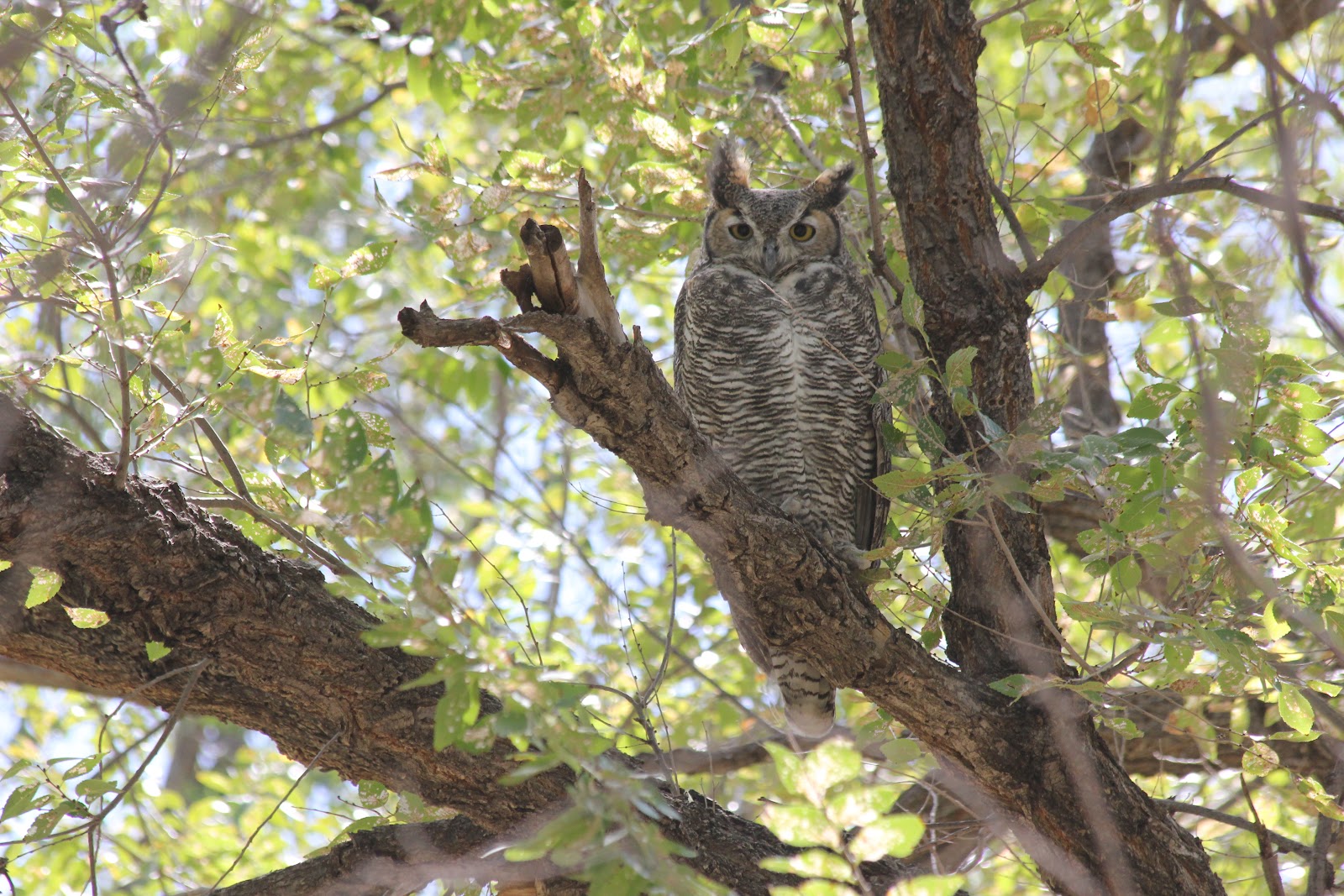
Post Park, yesterday, as with the 'blog post below regarding that time and place.
Great Horned Owls are year-round residents in the area, and over the majority of the continent. We certainly have at least one breeding pair around town (Marathon), and this individual could be one of that duet.
This species is King(& Queen)of the Jungle. An absolute apex-predator, the feet and talons on this bird are amazing. Great Horned Owls have excellent senses, most certainly that of hearing. However, one that isn't so keen is olfactory or the sense of smell. They are a key predator of skunk species so it kind of works out for them. Someone has to do it, from time to time.
Seeing a Great Horned Owl in Post Park isn't terribly uncommon. Yes, this bird is quite cryptic as it's camouflage is excellent. Open your mind (and eyes) up to the possibility, though. Then scan with your binoculars. Any slight glitch in the Matrix? Any subtle, vague, slightly-by-a-hair, less-than-congruent line in a tree branch... Go back to it. Maybe..?
Maybe not. This bird in the photo was right above my head. Sometimes we see less with binoculars than we do with our naked eyes. Sometimes in life.
The Great Horned Owl always gets to me. Always wins a staring contest, too. Regardless, gazing at this huge bird with those magnificent features, most certainly its eyes, I can't help wonder what all it really sees.
What all it sees (and then knows) that we cannot. Perhaps it sees more than we can handle. Same, with knowledge.
This bird was asleep when I first happened to notice it. Or was it? Looked like it to my eyes.
The photo was taken far later in the day, from a respectful distance.
Sunday, September 9, 2012
Fall Migration is Here
We are definitely seeing birds moving out, moving through, and moving in to our area.
With that I went to Post Park, south of Marathon by about 5 miles.
On the road to this Brewster County park I happened upon this individual at one of the cottonwood creek crossings:

Mississippi Kite, juvenile, (Ictinia mississippiensis)
This young kite is making its way to South America during our winter.

But for the moment, well at least last night and this morning, it spent some time just south of Marathon.
There were several neo-tropical migrating songbirds once I arrived at Post Park.

American Redstart, female (Setophaga ruticilla)
This redstart was actively foraging as they almost always are. This bird is extremely quick, never stopping long enough to allow me to photograph her. At this particular moment, she was well up in a tree..

The rest of her. Ha, what a great warbler to observe even when less than cooperative for a camera.

Plumbeous Vireo (Vireo plumbeous)
This vireo, in the same group of trees as the American Redstart, doesn't have nearly as far to go as that Mississippi Kite up top does.
Generally, this species is heading to the Pacific Coast of Mexico having just spent the spring and summer in the Inter-Mountain West of the U.S, which includes certain areas of the trans-Pecos of Texas.

Cassin's Vireo (Vireo cassinii)
This Cassin's Vireo is also headed to Mexico for the winter.
Certain bird species are arriving that just may stay the winter, our winter.

Clay-colored Sparrows (Spizella pallida)
Clay-colored Sparrows spend the spring and summer in northern portions of our continent including the Great Lakes region, the Dakotas, Montana, and the Interior Provinces of Canada.
We'll begin seeing and hearing a lot more of them during the fall migration season. These were the first of Fall for me. A few will stay the winter in certain portions of the trans-Pecos, but most are headed to Mexico and Central America.
There were other winter-residing sparrow species that were seen for the first time this Fall during the morning at Post.
The following is a list, generated by ebird, of the birds I saw, heard, and identified at Post Park this morning. Happy Fall Migration!
As at any point in this lifetime: Look around. Listen around.
Mississippi Kite, juvenile, (Ictinia mississippiensis)
This young kite is making its way to South America during our winter.
But for the moment, well at least last night and this morning, it spent some time just south of Marathon.
There were several neo-tropical migrating songbirds once I arrived at Post Park.
American Redstart, female (Setophaga ruticilla)
This redstart was actively foraging as they almost always are. This bird is extremely quick, never stopping long enough to allow me to photograph her. At this particular moment, she was well up in a tree..
The rest of her. Ha, what a great warbler to observe even when less than cooperative for a camera.
Plumbeous Vireo (Vireo plumbeous)
This vireo, in the same group of trees as the American Redstart, doesn't have nearly as far to go as that Mississippi Kite up top does.
Generally, this species is heading to the Pacific Coast of Mexico having just spent the spring and summer in the Inter-Mountain West of the U.S, which includes certain areas of the trans-Pecos of Texas.
Cassin's Vireo (Vireo cassinii)
This Cassin's Vireo is also headed to Mexico for the winter.
Certain bird species are arriving that just may stay the winter, our winter.
Clay-colored Sparrows (Spizella pallida)
Clay-colored Sparrows spend the spring and summer in northern portions of our continent including the Great Lakes region, the Dakotas, Montana, and the Interior Provinces of Canada.
We'll begin seeing and hearing a lot more of them during the fall migration season. These were the first of Fall for me. A few will stay the winter in certain portions of the trans-Pecos, but most are headed to Mexico and Central America.
There were other winter-residing sparrow species that were seen for the first time this Fall during the morning at Post.
The following is a list, generated by ebird, of the birds I saw, heard, and identified at Post Park this morning. Happy Fall Migration!
As at any point in this lifetime: Look around. Listen around.
1 | Mallard (Mexican) Anas platyrhynchos diazi
orange bill indicates female
Age & Sex
| ||||||||||||||||||||
|---|---|---|---|---|---|---|---|---|---|---|---|---|---|---|---|---|---|---|---|---|---|
25 | Turkey Vulture Cathartes aura | ||||||||||||||||||||
1 | Cooper's Hawk Accipiter cooperii | ||||||||||||||||||||
1 | Red-tailed Hawk Buteo jamaicensis | ||||||||||||||||||||
3 | American Coot Fulica americana | ||||||||||||||||||||
10 | White-winged Dove Zenaida asiatica | ||||||||||||||||||||
15 | Mourning Dove Zenaida macroura | ||||||||||||||||||||
1 | Great Horned Owl Bubo virginianus | ||||||||||||||||||||
2 | Black-chinned Hummingbird Archilochus alexandri
Archilochus sp. female.
Age & Sex
| ||||||||||||||||||||
5 | Golden-fronted Woodpecker Melanerpes aurifrons | ||||||||||||||||||||
4 | Western Wood-Pewee Contopus sordidulus | ||||||||||||||||||||
5 | Vermilion Flycatcher Pyrocephalus rubinus | ||||||||||||||||||||
2 | Bell's Vireo Vireo bellii | ||||||||||||||||||||
1 | Plumbeous Vireo Vireo plumbeus
FOF
| ||||||||||||||||||||
1 | Cassin's Vireo Vireo cassinii | ||||||||||||||||||||
10 | Barn Swallow Hirundo rustica | ||||||||||||||||||||
1 | Canyon Wren Catherpes mexicanus | ||||||||||||||||||||
2 | House Wren Troglodytes aedon
2 heard, from opposite ends of the park (opposite ends of the creek) one showed itself. Fairly round, drab-ish brown wren that lacked a distinctive supercilium. Fairly short tail. FOF in TX
| ||||||||||||||||||||
2 | Marsh Wren Cistothorus palustris
two birds in separate locations respectively of the park, deep in reeds. Both vocalizing to make presence known. FOF.
| ||||||||||||||||||||
2 | Northern Mockingbird Mimus polyglottos | ||||||||||||||||||||
1 | American Redstart Setophaga ruticillaAge & Sex
| ||||||||||||||||||||
5 | Wilson's Warbler Cardellina pusilla | ||||||||||||||||||||
2 | Canyon Towhee Melozone fusca | ||||||||||||||||||||
3 | Chipping Sparrow Spizella passerina
FOF
| ||||||||||||||||||||
4 | Clay-colored Sparrow Spizella pallida
FOF
| ||||||||||||||||||||
2 | Lincoln's Sparrow Melospiza lincolnii
first heard vocalizing with the fairly distinctive, solid/firm "chip" . One popped out of creek to perch on fence as they both continued to "chip." FOF
| ||||||||||||||||||||
3 | Summer Tanager Piranga rubra | ||||||||||||||||||||
3 | Lazuli Bunting Passerina amoenaAge & Sex
| ||||||||||||||||||||
2 | Indigo Bunting Passerina cyanea
2 females hanging around with a female PABU
Age & Sex
| ||||||||||||||||||||
2 | Painted Bunting Passerina cirisAge & Sex
| ||||||||||||||||||||
10 | Red-winged Blackbird Agelaius phoeniceus | ||||||||||||||||||||
3 | Great-tailed Grackle Quiscalus mexicanus | ||||||||||||||||||||
2 | House Finch Haemorhous mexicanus |
Subscribe to:
Posts (Atom)