Tuesday, September 17, 2013

Migration is no fairy tale

In all causes of mortality, there are questions.

Why? 

How? 

...and often enough, the answers are simple.

Humans.

Birds have been documented at lighthouses - fluttering, trapped in the beam of light - since the 1800s.

Artificial light causes birds to become disoriented.

Glass is not a new technology. Prior to WWII, large panes of glass were expensive and of questionable clarity/quality. The following industrial boom, however, made sheet glass commonplace in architecture.

There's nothing like it in nature.  

Wind turbine technology went from the literal wind mill - for milling grain into flour, using broad, wooden, canvas, or metal blades - into 10x the height, 8x the width, and speeds ranging well into 100 mph range.

There has been no coevolution with this technology.

Cell towers have wires to anchor them. Power lines. Same story as above, but this time, a little closer to home.

Oversimplified? Very. But it does matter. Because there is no need for this:
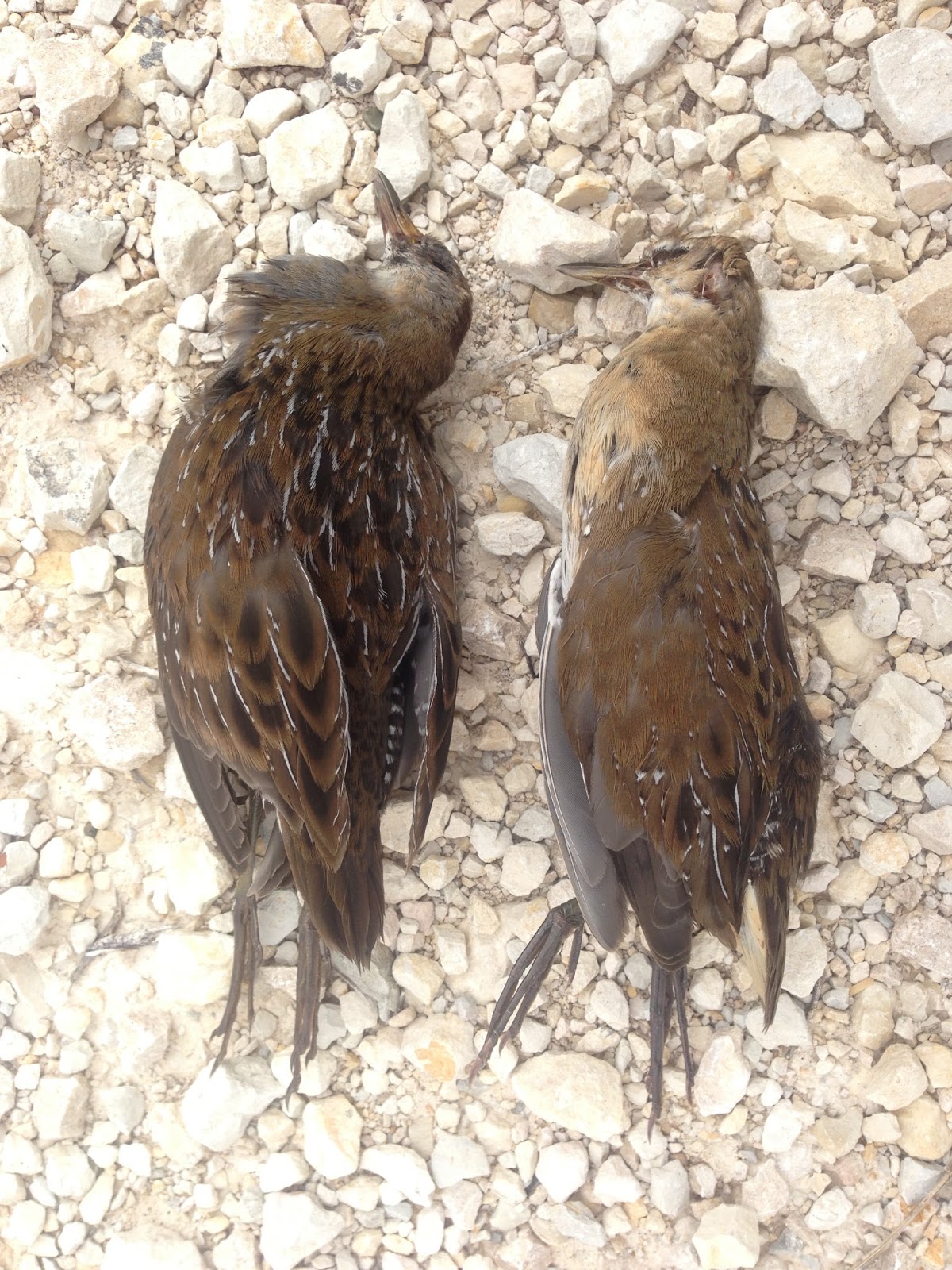
Sora (Porzana carolina), power line kills, Brewster County, TX 17 Sept. 2013 - photo by Matt York
These are two Porzana carolina, or Sora. They were directly beneath power lines, not a stone's throw from a moist, Sora-friendly stopover point. Not terribly far from where this Redhead met power lines.

It is important to note - in all things - that birds are not helicopters. Hummingbirds are close to being an exception, but they are by far the outliers. Especially around water, where large, heavy-bodied birds are regularly traveling, it is hazardous to have power lines, cell towers, wind turbines, or large windows: even small, lightweight birds heading to or from the water need air space for takeoff and landing. Some airports are wedged into narrow corridors, but engineers would never dream of having massive aircraft land or takeoff from a runway boxed in at the ends by huge obstacles. The differences is that birds simply cannot perceive the obstacles and have no civil engineer to plan their routes. Since the dawn of their migratory patterns, changes in their habitats have been gradual. Only in a relatively short amount of time (it's all relative) have humans significantly, and quickly, altered their migration habitats in ways that are drastically different from year to year.

Sora (Porzana carolina), power line kill, with Sibley's Western Guide, Brewster County, TX 17 Sept. 2013 - photo by Matt York
We are within the winter range for Sora; what we lack is habitat, and observable habitat. My only previous sighting for Brewster County was 23 October 2011, at Post Park. If my memory serves, it was an adult. These two, as illustrated in Sibley's book, were in the buffiness of youth. Juvenile plumage. Subtle coloration that matched the grass. These two were within 20, perhaps 15 feet of each other. An overcast morning, following an overcast evening after an overcast day. What are the odds? No, really. What are they? Sora are well documented as window kills throughout North America (Chicago, Toronto, NY, you name it - even Stillwater, Oklahoma) but to have two that apparently struck at the same time... were there 2 Sora? And both hit? Were there more? Was it 2 of 10? Surely 10 is too high a number - they're not particularly flocking creatures - but what do we know?

Two sora, three power lines, and a curiosity for what will be found in the future.

"I don't need a weapon! My friends are my power!" —Sora

If only. 

...if only.

* These two birds will go to the collections at Texas A&M University, per our permits. Call it science.

Tuesday, September 10, 2013

Fade to Black: Migration Continues

Heidi and I made it back to the Marathon Treatment Ponds this morning.

**Remember, this is on PRIVATE PROPERTY in which you have to drive through Private Property to reach it. We have been granted access.  Should you feel the urge, if you are out here, gently contact Heidi.  Our contact info remains on the side-bar.**

While there were sadly no ducks on the ponds beyond the "Mexican" Mallard residents, we did have Western Sandpipers (Calidris mauri), a Least Sandpiper (C. minutilla), and a calling, circling Baird's Sandpiper (C. bairdii).

All nice birds, but otherwise not much going on.  So we trekked south to check the mesquites for any warblers or other migrants.  Nothing much happening.

Walking back to the truck, which ultimately takes us back past the ponds, we had a quick glance at a fast-moving and different shape.


Black Tern (Chlidonias niger)

This is a young bird, what is often referred to a "1st Year" bird.  That is, it is in its first calender year of existence.  It hatched earlier this year from locations that could be as far north as the Northwest Territories, Canada.

Most Black Terns winter in South America, though some will do so as far north as the coast of SW Mexico.

Basically, this young bird has a long ways to go yet; well beyond north Brewster County, TX.


As we watched this entertaining and beautiful young bird, Heidi astutely pointed out that "it has yet to see the coast.."
Let's hope it does, but migration is no fairy tale.

Should this young tern make it back to its species' spring/summer breeding grounds, its plumage will be mostly black, with sooty-gray wings, and a section of white from lower belly to vent.  A gorgeous bird.


As members of Family Laridae go (Gulls, Terns, Skimmers), this is a fairly small species with an average wingspan of around 24 inches.


Those are, after all, mesquites in the background, not Sequoias.

Most terns are plunge-divers. They "plunge-dive" for food.  This young Black Tern kept diving down, but pulling up right before the water's surface.

Constantly.

This species also feeds on flying insects.


While not bad forage-value for sandpipers and dabbling ducks, these water-treatment ponds hold little-to-no food for a plunge-diving tern.


The distances some birds must travel during spring and fall migration are astounding.  Certain tern species are among the longest.

Here's a rough range map for the Black Tern:


Remember, this young bird dropped down to these treatment ponds after we already had been out there for perhaps 45 minutes.

It is on the move.


We were, of course, super-excited to see this individual in our corner of the Chihuahuan Desert this mid-morning.
However, again, this young tern has a long, long ways to go.

As we can all use a little bit in this life, and some more than others, we wish it:

Good luck.
Buena suerte.


Thursday, September 5, 2013

Soon..

... there will hundreds at a glance.  Thousands.  Flocks so large on the trans-Pecos horizons it may look like wisps and puffs of smoke.

However, for now; well, as of a couple of days ago there is one.

This one:

Lark Bunting (Calamospiza melanocorys), male


In high-desert grasslands such as the Marfa Plateau or our Marathon Basin, the number of Lark Buntings can be staggering.  Large, seed-eating flocks questioning us with a call of "What?..What?"

My first returning Lark Bunting noticed was back on the 18th of July.  Yes, we also had a single group of seven fly over-head on August 10th.  That's been it.  The single male in mid-July may have been this particular male, photographed a few days ago in the same general area as seen over a month prior.

For a bird that spends much of its life in such large flocks, I wonder if a sense of liberation at being the "first" on a wintering-ground is felt or loneliness?  Both?  That question is ofcourse far more human than bunting, but still..

If it was a call to all or a call to none, no matter; it won't be terribly long.


He will also lose that dapper, black suit of feathers; his summer-breeding plumage.

Welcome back.

What?


Saturday, August 31, 2013

Migrating sandpipers.

Here's one.

Baird's Sandpiper (Calidris bairdii)

A significant percentage of fall migration is represented by "shorebirds." Many sandpipers, Family Scolopacidae, are among our longer distance migrating species.

Many of these are "tundra-nesters."  They spend their summer breeding season in the far-edges of northern latitudes.

Here's a range map for the Baird's Sandpiper as an example:


I came across this individual at the *Marathon Treatment Ponds in Brewster County, right here in our corner of the Chihuahuan Desert. When Heidi came by on her lunch break, there were two.

No doubt this bird was quite okay taking advantage of this body of water, even before it has been treated. As you see in the map above, this bird has a long ways yet to go.


A few ID tips on this species would include noting how the outer primary ("flight-feathers") feathers project beyond the tail.  In the photo above we can see a nearly solid black feather projecting further than the white-outlined tail feather.

Additionally, take a look at the first picture.  Notice the buffy breast.  This bird is a fairly "large" sandpiper, and that color existing on its breast also helps eliminate some possible species.  Yes, the bird's overall size does as well.

While water is a key component for many species, they still have to travel great distances, at times, to find another puddle.

While we have migration buzzing all around us right now, many species are nocturnal migrants.  That includes this featured sandpiper.


So look up and listen up.  Even overnight; perhaps particularly at night.

 If you hear the following late at night, you could be hearing the Baird's Sandpiper migrating overhead:

http://macaulaylibrary.org/audio/24039

Well, in this recording you would be hearing several.

*Marathon Treatment Ponds are PRIVATE property.  We have been granted access.

Saturday, August 24, 2013

Migration is Upon Us..

... and has been for a recent while now.  Discovered yesterday at the treatment ponds, one excellent bird for the Marathon Basin was this individual:

Forster's Tern  (Sterna forsteri)

Also at the Marathon Treatment Ponds were over 30 Wilson's Phalarope.


Wilson's Phalarope (Phalaropus tricolor)

In addition, there were a Lesser Yellowlegs (Tringa flavipes), a Western Sandpiper (Calidris mauri), and a Least Sandpiper (C. minutilla).

The Marathon Treatment Ponds are on private property.  We have been granted access.  So do respect, if you are out here, private property.  You might give Heidi Trudell a call or email regarding this property.  As always, it can only take one time to screw up access for all of us.

Anyways, nothing too Earth-shattering but it is nice for us to begin to observe a leading edge of migration happening on our corner of the Chihuahuan Desert.

One of the earliest migrating species is Rufous Hummingbird.  We have played host to them here at Casa de Dos Baños (CDB).


Rufous Hummingbird (Selasphorus rufus), male.

I had the wrong settings on the camera for this guy, so I had to go with a feeder shot. When spinning the dials on the SLR, I should double-check said dials.

For the bird-people reading this, check the notch on both R2 feathers.

We do get Allen's Hummingbirds (S. sasin) out here during migration.  More so than certain field guides would suggest.  Such data and questions and "seriously??"- type inquires might should be directed toward Kelly Bryan and his West Texas Avian Research.  He has already had one of his earliest (the earliest?) Allen's show up this year.

We have had several Rufous Hummingbirds this early Fall, with some evident turnover.  However, we've yet to get Allen's Hummingbird here at the CDB.  We expect to at some point, as we've hosted them in town in past migrations.

Cheers, and here's to a great migration out here and throughout the state!

Friday, August 23, 2013

Post Park, in photos

Just focusing on the water, not the picnic tables, facilities, etc. filing for future reference.