The blog has been a bit strange lately, with a lot of travel, fire, and, well... here's the bird update in the meantime. It's been a busy week or three for the freezer* (salvage permits through Texas A&M).
Apologies for starting off a post with a decapitated Scott's Oriole (Icterus parisorum), but this is just chronological order for bird photos this month so far.
There is a responsibility when feeding birds, to ensure that they are reasonably safe from harm. So scattering seed in an area known to threaten birds would be unethical; in the middle of a road, for example. The 'Double Bacon' doesn't have any ground feeding options at all due to cats in the area and oriole/hummingbird feeding stations are quite high - it's an attempt to give birds the upper hand. The oriole above was killed directly under the [low] orange upon which it fed; (to be clear, it was not at the Double Bacon). The easy answer is to not feed birds at all if known threats are unavoidable.
Now for a roadkill fresh off of someone's bumper; an Empidonax flycatcher of uncertain ID, leaning towards Dusky Flycatcher (Empidonax oberholseri). The eye ring was not really visible, dessicated as the critter was getting, but everything else was favorable. See the next Empid ID challenge for more commentary!
Near miss with a bumper: female Painted Bunting (Passerina ciris), 'rolled' (uninjured on the road) on Hwy 385 between Marathon and Fort Stockton. She had no visible injuries, no broken wings, legs, etc, no blood anywhere, clear eyes and zero response when she was picked up in the middle of the road. Not having a box handy (shame on me!) I placed her under a bush; often enough, after a few hours the stunned bird is able to fly away. Generally being kept in a dark, safe, predator/car-free box is the preferred method in case complications arise. Rehabbers will love you for it.
This next little fellow, unfortunately, is a male Painted Bunting (Passerina ciris) who hit a French door. While generally the 'French door' modifications on sheet glass / glass doors can help, it's certainly not foolproof; birds will hit pretty much any glass surface as long as the surface is larger than the bird. There's a certain fondness for old timey glass that's slightly bubbly or warped on the surface because it tends to not reflect as well and also be in small enough pieces that there's more framework to support it. Those factors combined help reduce window kills.
Some day there will be a post on how to tell what killed a bird. While this is not that post, the bird above is a female Common Yellowthroat (Geothlypis trichas), killed by a cat. At first glance, such an intact critter would likely be a window kill, and that's not entirely ruled out. However, only having one or two tail feathers left would indicate that a cat got ahold of it; if not before death, after. It was either a short struggle, or none at all (there have been studies documenting cats and crows lurking around windows, waiting for birds to hit).
"A bird in the hand is worth two in the bush." Yes, but unless you have the Pyle guide to measure physiological aspects of the bird, Empidonax flycatchers are sometimes best left in the field. We suspect that the above creature was a Gray Flycatcher, (Empidonax wrightii), but it had more of a tangle with a cat than the previous bird, so field marks are a bit more mangled. In the field, we'd hopefully get a call note, a perching height/habitat preference, perhaps even characteristic tail wags. In the hand, this bird has ants.
Another flycatcher! This time, a Western Wood-Pewee (Contopus sordidulus), splendid specimen found as roadkill on a day when the smoke in town was so thick that Marathon felt like LA; couldn't see the mountains on ANY side! Flying low must have been an attempt to stay out of the smoke, or a conservation of energy... a lot of things have been flying low, or sitting on the ground (Barn Swallows, especially) while waiting for bugs to pop up. It's a rough drought.
The above three birds were picked up on Friday the 13th (Freezerday the 13th?)
The Yellow-breasted Chat (Icteria virens) above was lucky, in a way, to have been found alive. No tail at all, no rump feathers, no secondaries on the right wing (those are the ones that provide lift). Intact, hunting for insects, unable to escape a cat. So, rudder and lift-less, unable to escape from humans, we snatched him up and drove him to Fort Davis.
From the rehabber:
"Thanks for bringing him to me. He has some serious cat injuries which take a toll within the first 24 hours. He is feisty, and has eaten grapes, suet, soaked cat food, but his favorite is human fingers." [Note that the photo shows the chat latched on to a finger!]
No news, however, since the Sunday night e-mail.
Next up in roadkill: Blue Grosbeak (Guiraca caerulea). I suspect that our increased explorations along Hwy 385 will turn up quite a bit of freezer content. Roadkill itself makes more sense than window kills; there's momentum on all sides, unlike the static mirage of a window. It is generally unavoidable, though I bristle when people do not at least tap the brakes when approaching large, cumbersome, perched-on-the-ground Turkey Vultures who need to take off into the wind. Yes; most get out of the way in time. But give them the benefit of the doubt, for they DO shatter windshields.
I digress.
Last and quite diminutive, Audubon's Yellow-rumped Warbler (Dendroica coronata auduboni) is something I hadn't expected to be roadkill. But with their tendency to ground forage, perhaps I shouldn't be so surprised. The lovely male above was likely going to stick around and breed in this area, a very narrow sliver of Yellow-rumped Warbler nesting range... other than the chat (if you can really call it a warbler), there's not a whole lot of warbler breeding out here. At least we lucked out and got the eye-candy of yellow-rumps! ('Audubon's' Yellow-rumped Warbler is the showy, yellow-chinned western counterpart of the 'Myrtle' Yellow-rumped Warbler, who has a white chin, among other things.)
Eventually I hope to have full posts up, one post per critter or two, with the various angles of wings/tails, etc for future reference. For some reason the color of down feathers strikes me as especially interesting because white/gray/black down seems to be somewhat randomly scattered through the critters, but my work with dead birds is still relatively* limited. (Relatively, considering some folks spend their lives preparing specimens and working in/around collections!)
Also, let it be known that Matt has found a good majority of the critters in this post. Between the two of us, a dead bird out here doesn't stand much chance of escaping an 'afterlife' in scientific/academic data!
Wednesday, May 18, 2011
Tuesday, May 17, 2011
Drought?
Drought.
It's in the fields. It's in the meadows. It's in the mountains. It's in the basins.
Its in our lives.
Not all. Parts.
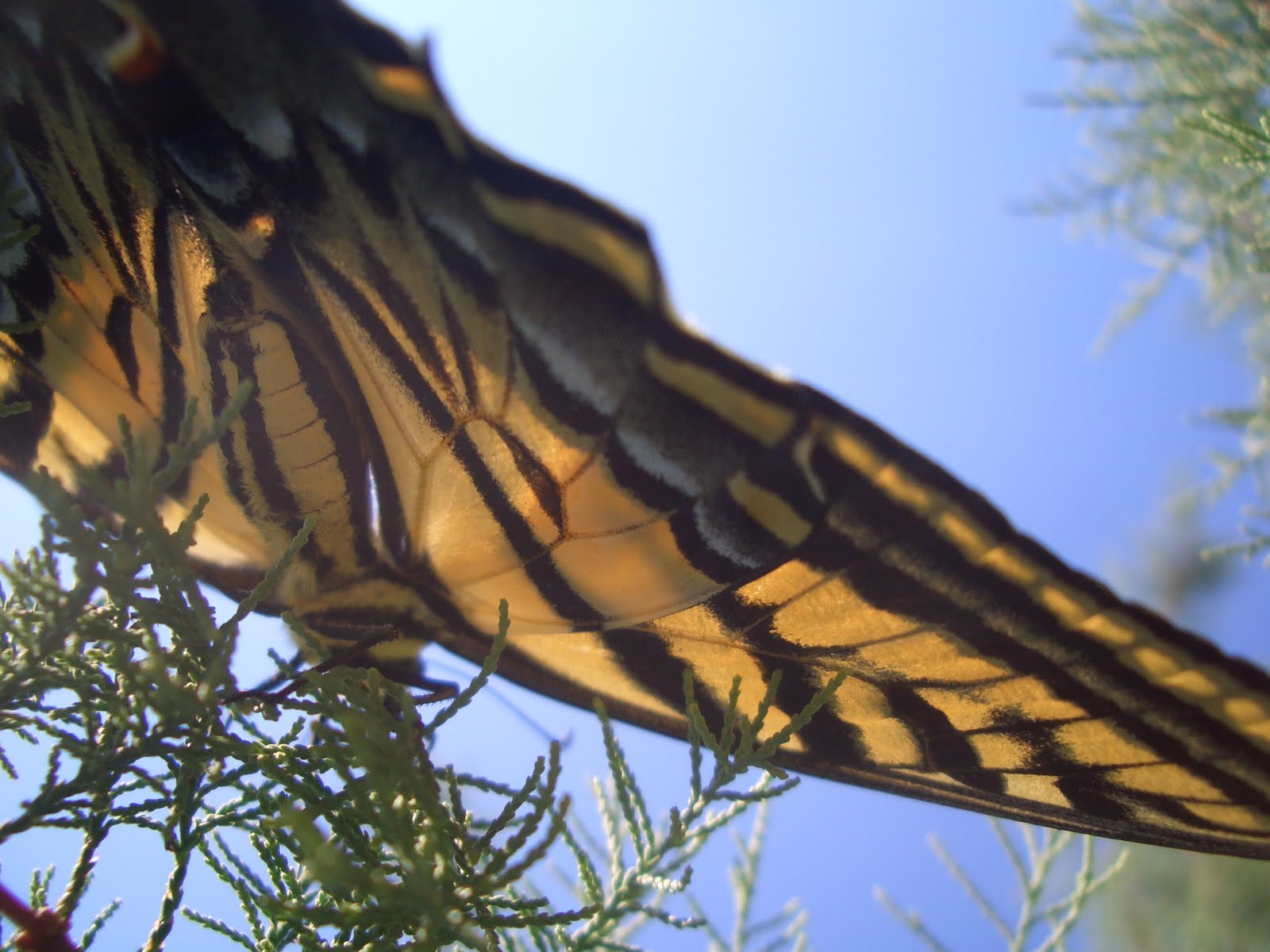
Yesterday morning I noticed something differently aglow in the after-dew of early morning. Perched in a pinyon. Later in a tamarix.

Attempting what all have come to be in this part of the Earth; dried off and warmed up.
Butterflies have been very, very scarce with this drought. An early-season flight of a few species and then nothing. As common as rain drops in this fire-happy area.
This a butterfly. A real beauty. One of the larger, perhaps largest of the western butterflies.

Two-tailed Swallowtail (Papilio multicaudata)
There are moments in our lives when some … thing(?)… attempts to cross our minds with certain reminders.
Its up to us to be observers. The less-observant will likely miss it. They often do. A few always.
What, then, are we told? Well there are many things, observer.

One..
“Hang on. Shi…Stuff happens. It’s going to be alright. Work on remembering this.”

Again, we need not name this Orator. Its all around us, observer. Names are unnecessary, human things. Names start wars, observer. Unnecessary.

Those who work so hard to name It, and that only, miss everything. Unnecessarily.

“Hang on.

Stuff happens.

It's going to be alright.
Work on remembering this.

You are not alone, observer." - Butterfly
For a moment that morning, in spite of all that's around me, I ask no one and everything,
"What drought?"
photos by Heidi Trudell
It's in the fields. It's in the meadows. It's in the mountains. It's in the basins.
Its in our lives.
Not all. Parts.
Yesterday morning I noticed something differently aglow in the after-dew of early morning. Perched in a pinyon. Later in a tamarix.
Attempting what all have come to be in this part of the Earth; dried off and warmed up.
Butterflies have been very, very scarce with this drought. An early-season flight of a few species and then nothing. As common as rain drops in this fire-happy area.
This a butterfly. A real beauty. One of the larger, perhaps largest of the western butterflies.
Two-tailed Swallowtail (Papilio multicaudata)
There are moments in our lives when some … thing(?)… attempts to cross our minds with certain reminders.
Its up to us to be observers. The less-observant will likely miss it. They often do. A few always.
What, then, are we told? Well there are many things, observer.
One..
“Hang on. Shi…Stuff happens. It’s going to be alright. Work on remembering this.”
Again, we need not name this Orator. Its all around us, observer. Names are unnecessary, human things. Names start wars, observer. Unnecessary.
Those who work so hard to name It, and that only, miss everything. Unnecessarily.
“Hang on.
Stuff happens.
It's going to be alright.
Work on remembering this.
You are not alone, observer." - Butterfly
For a moment that morning, in spite of all that's around me, I ask no one and everything,
"What drought?"
photos by Heidi Trudell
Thursday, May 12, 2011
Hwy 90 between Sanderson and Marathon CLOSED
At this time due to firefighting operations on Schwartz fire. We've learned that firefighters are going to back-burn north of Hwy 90 to reduce fuel load .
noon update from Marfa Public Radio
Wednesday, May 11, 2011
Post Park - more migrants!
Edit: Iron Mountain fire update "The Iron Mountain Fire has consumed 15,675 acres. Officials are calling that fire around 25% contained."
This morning we were joined by a lovely couple from Maine who had birded south Texas before, but were new to the Big Bend region. While there were a good number of migrants, there were also a few 'first of season' (FOS) critters in attendance as well. Interesting/migrant/FOS birds are in bold. It's been a slow spring, but at least it's finally here!
Marathon - Ft. Peña Colorado Pk (The Post)
Species list:
3 Scaled Quail
1 Pied-billed Grebe
20 Turkey Vulture
1 Osprey
1 American Coot
1 Killdeer
3 Spotted Sandpiper
15 White-winged Dove
4 Mourning Dove
1 Yellow-billed Cuckoo FOS
6 Golden-fronted Woodpecker
1 Ladder-backed Woodpecker
1 Olive-sided Flycatcher
1 Western Wood-Pewee FOS
1 Gray Flycatcher
1 Dusky Flycatcher
1 Empidonax sp.
8 Vermilion Flycatcher
1 Ash-throated Flycatcher
1 Cassin's Kingbird
6 Western Kingbird
2 Bell's Vireo
3 Warbling Vireo
3 Northern Rough-winged Swallow
1 Violet-green Swallow
4 Barn Swallow
1 Cave Swallow
1 Verdin (heard only)
3 Cactus Wren
1 Marsh Wren
1 Black-tailed Gnatcatcher
1 Hermit Thrush
1 Gray Catbird
2 Northern Mockingbird
1 Yellow Warbler
1 Yellow-rumped Warbler (Myrtle)
10 Yellow-rumped Warbler (Audubon's)
1 Black-throated Gray Warbler
20 Wilson's Warbler
1 Yellow-breasted Chat
1 Rufous-crowned Sparrow
4 Canyon Towhee
4 Chipping Sparrow
10 Clay-colored Sparrow
1 Lark Sparrow
1 Lincoln's Sparrow
6 White-crowned Sparrow
4 Summer Tanager
1 Western Tanager
2 Northern Cardinal
1 Black-headed Grosbeak
15 Blue Grosbeak
2 Indigo Bunting
3 Painted Bunting
1 Red-winged Blackbird
3 Bronzed Cowbird
5 Brown-headed Cowbird
2 House Finch
Total species reported: 57
Post Road:
Greater Roadrunner
Red-tailed Hawk
Other things of interest:
Monarch
Black Swallowtail
Blue spp (none cooperated!)
Whiptail spp
This morning we were joined by a lovely couple from Maine who had birded south Texas before, but were new to the Big Bend region. While there were a good number of migrants, there were also a few 'first of season' (FOS) critters in attendance as well. Interesting/migrant/FOS birds are in bold. It's been a slow spring, but at least it's finally here!
Marathon - Ft. Peña Colorado Pk (The Post)
Species list:
3 Scaled Quail
1 Pied-billed Grebe
20 Turkey Vulture
1 Osprey
1 American Coot
1 Killdeer
3 Spotted Sandpiper
15 White-winged Dove
4 Mourning Dove
1 Yellow-billed Cuckoo FOS
6 Golden-fronted Woodpecker
1 Ladder-backed Woodpecker
1 Olive-sided Flycatcher
1 Western Wood-Pewee FOS
1 Gray Flycatcher
1 Dusky Flycatcher
1 Empidonax sp.
8 Vermilion Flycatcher
1 Ash-throated Flycatcher
1 Cassin's Kingbird
6 Western Kingbird
2 Bell's Vireo
3 Warbling Vireo
3 Northern Rough-winged Swallow
1 Violet-green Swallow
4 Barn Swallow
1 Cave Swallow
1 Verdin (heard only)
3 Cactus Wren
1 Marsh Wren
1 Black-tailed Gnatcatcher
1 Hermit Thrush
1 Gray Catbird
2 Northern Mockingbird
1 Yellow Warbler
1 Yellow-rumped Warbler (Myrtle)
10 Yellow-rumped Warbler (Audubon's)
1 Black-throated Gray Warbler
20 Wilson's Warbler
1 Yellow-breasted Chat
1 Rufous-crowned Sparrow
4 Canyon Towhee
4 Chipping Sparrow
10 Clay-colored Sparrow
1 Lark Sparrow
1 Lincoln's Sparrow
6 White-crowned Sparrow
4 Summer Tanager
1 Western Tanager
2 Northern Cardinal
1 Black-headed Grosbeak
15 Blue Grosbeak
2 Indigo Bunting
3 Painted Bunting
1 Red-winged Blackbird
3 Bronzed Cowbird
5 Brown-headed Cowbird
2 House Finch
Total species reported: 57
Post Road:
Greater Roadrunner
Red-tailed Hawk
Other things of interest:
Monarch
Black Swallowtail
Blue spp (none cooperated!)
Whiptail spp
Tuesday, May 10, 2011
Marathon area fires
There are no road closures that we know of for this batch of fires:
Iron Mountain fire is *just* north of Marathon/Hwy 90; it is spreading east toward Hwy 385.
Schwartz fire is east of Marathon, north of Hwy 90 and spreading slowly west toward Hwy 385.
Gage/Holland fire is a bit west of Alpine, not sure which side of Hwy 90 it's on.
Marfa Public Radio link with audio update
Photo 1, facing west, taken at the prairie dog town 10 miles north of Hwy 90 on Tuesday afternoon shortly before 3 pm. Photo 2, facing east, taken near the prairie dog town, same time/date.

Iron Mountain fire is *just* north of Marathon/Hwy 90; it is spreading east toward Hwy 385.
Schwartz fire is east of Marathon, north of Hwy 90 and spreading slowly west toward Hwy 385.
Gage/Holland fire is a bit west of Alpine, not sure which side of Hwy 90 it's on.
Marfa Public Radio link with audio update
Photo 1, facing west, taken at the prairie dog town 10 miles north of Hwy 90 on Tuesday afternoon shortly before 3 pm. Photo 2, facing east, taken near the prairie dog town, same time/date.
Wednesday, May 4, 2011
Brewster County Birding Karma
This is our preliminary 'weekend' report (our weekend is Tues/Weds), with notable sighitngs in bold. While Rose-breasted Grosbeak was reported from Rio Grande Village as well as Christmas Mountains Oasis, we missed them along with Crissal Thrasher. But for very little effort we racked up a good number of critters. So, so many critters.
Report Details
Date range: May 1, 2011 - May 7, 2011 Total # of Species: 92
Total # of Checklists: 8
Location(s): Big Bend NP--Rio Grande Village; Big Bend Ranch SP - Barton Warnock Visitors Ctr. (Brewster Co.); Brewster; Christmas Mountain Oasis; Terlingua- Ghost Town area
Summary
May 1 May 2 May 3 May 4 May 5 May 6 May 7
Number of Species -- 6 63 77 -- -- --
Number of Individuals -- 3 40 1 -- -- --
Number of Checklists -- 2 5 1 -- -- --
Highest Count for a Species Show Sample Size
Species Name May 1 May 2 May 3 May 4 May 5 May 6 May 7
Mallard (Mexican) -- -- -- X -- -- --
Scaled Quail -- X X X -- -- --
Green Heron -- -- -- X -- -- --
Black Vulture -- -- -- X -- -- --
Turkey Vulture -- -- X X -- -- --
Northern Harrier -- 1 -- -- -- -- --
Common Black-Hawk -- -- -- X -- -- --
Gray Hawk -- -- -- X -- -- --
Zone-tailed Hawk -- -- 1 X -- -- --
Red-tailed Hawk -- -- 1 -- -- -- --
American Kestrel -- -- 1 -- -- -- --
Killdeer -- -- X X -- -- --
Solitary Sandpiper -- -- -- X -- -- --
Eurasian Collared-Dove -- -- 2 -- -- -- --
White-winged Dove -- -- X X -- -- --
Mourning Dove -- X X X -- -- --
Common Ground-Dove -- -- -- X -- -- --
Greater Roadrunner -- -- X X -- -- --
Elf Owl -- 1 -- -- -- -- --
White-throated Swift -- -- -- X -- -- --
Lucifer Hummingbird -- -- 2 -- -- -- --
Black-chinned Hummingbird -- -- 5 -- -- -- --
Golden-fronted Woodpecker -- -- X X -- -- --
Ladder-backed Woodpecker -- 1 1 X -- -- --
Gray Flycatcher -- -- X X -- -- --
Dusky Flycatcher -- -- X -- -- -- --
Black Phoebe -- -- -- X -- -- --
Say's Phoebe -- -- X X -- -- --
Vermilion Flycatcher -- -- X X -- -- --
Ash-throated Flycatcher -- -- X X -- -- --
Western Kingbird -- -- 1 X -- -- --
Loggerhead Shrike -- -- -- X -- -- --
Bell's Vireo -- -- X X -- -- --
Plumbeous Vireo -- -- -- X -- -- --
Common Raven -- -- X X -- -- --
Northern Rough-winged Swallow -- -- -- X -- -- --
Barn Swallow -- -- 2 X -- -- --
Cliff Swallow -- -- -- X -- -- --
Verdin -- -- 1 X -- -- --
Cactus Wren -- -- X X -- -- --
House Wren -- -- 1 -- -- -- --
Black-tailed Gnatcatcher -- -- -- X -- -- --
Swainson's Thrush -- -- 2 X -- -- --
Hermit Thrush -- -- -- X -- -- --
Gray Catbird -- -- -- X -- -- --
Northern Mockingbird -- -- X X -- -- --
Curve-billed Thrasher -- -- X X -- -- --
Nashville Warbler -- -- 2 X -- -- --
Yellow Warbler -- -- X X -- -- --
Yellow-rumped Warbler -- -- X X -- -- --
Townsend's Warbler -- -- -- X -- -- --
Black-and-white Warbler -- -- -- X -- -- --
American Redstart -- -- -- X -- -- --
Ovenbird -- -- -- X -- -- --
Northern Waterthrush -- -- -- X -- -- --
MacGillivray's Warbler -- -- -- X -- -- --
Common Yellowthroat -- -- -- X -- -- --
Wilson's Warbler -- -- X X -- -- --
Yellow-breasted Chat -- -- X X -- -- --
Green-tailed Towhee -- -- 2 X -- -- --
Canyon Towhee -- X X -- -- -- --
Chipping Sparrow -- -- X X -- -- --
Clay-colored Sparrow -- -- X X -- -- --
Brewer's Sparrow -- -- X X -- -- --
Vesper Sparrow -- -- X X -- -- --
Lark Sparrow -- -- X X -- -- --
Black-throated Sparrow -- -- X X -- -- --
Lark Bunting -- -- 3 X -- -- --
Savannah Sparrow -- -- X -- -- -- --
Lincoln's Sparrow -- -- -- X -- -- --
White-crowned Sparrow -- -- X X -- -- --
Summer Tanager -- -- -- X -- -- --
Scarlet Tanager -- -- -- 1 -- -- --
Western Tanager -- -- 3 X -- -- --
Northern Cardinal -- -- X X -- -- --
Pyrrhuloxia -- -- X X -- -- --
Black-headed Grosbeak -- -- 2 X -- -- --
Blue Grosbeak -- -- X X -- -- --
Lazuli Bunting -- -- 1 X -- -- --
Indigo Bunting -- -- X X -- -- --
Varied Bunting -- -- 3 -- -- -- --
Painted Bunting -- -- X X -- -- --
Red-winged Blackbird -- -- X -- -- -- --
Yellow-headed Blackbird -- -- 1 -- -- -- --
Brewer's Blackbird -- -- X X -- -- --
Brown-headed Cowbird -- -- X X -- -- --
Hooded Oriole -- -- -- X -- -- --
Bullock's Oriole -- -- X X -- -- --
Scott's Oriole -- -- 1 X -- -- --
House Finch -- -- X X -- -- --
American Goldfinch -- -- 1 -- -- -- --
House Sparrow -- -- X X -- -- --
Northern Harrier - adult male, VERY late!
Common Black-Hawk - in the nesting area at RGV
Gray Hawk - pair calling over RGV store and Daniel's Ranch
Zone-tailed Hawk - at least 3 individuals in the region
Elf Owl - heard only at CMO
Lucifer Hummingbird - displaying at CMO
Black-and-white Warbler - still haven't left?
American Redstart - young male
Ovenbird - out in the open acting like a pipit, palest crown markings we've ever seen
Northern Waterthrush - waggling through flooded campground
MacGillivray's Warbler - wins the least cooperative bird of the trip award
Green-tailed Towhee - EVERYWHERE, very strange!
Lark Bunting - still. not. gone.
Scarlet Tanager - startled us by cooperating near Daniel's Ranch
Lazuli Bunting - two males and a female at RGV, female at CMO
Indigo Bunting - quite common around RGV
Varied Bunting - CMO, most cooperative sightings of this spp to date
Painted Bunting - worse than Wilson's Warblers!
Eventually we'll get the numbers deciphered from notes, but the sheer number of Indigo and Painted Buntings was mind-boggling. Now we know why the rest of west TX has no other birds; they're still hanging around BBNP!
Report Details
Date range: May 1, 2011 - May 7, 2011 Total # of Species: 92
Total # of Checklists: 8
Location(s): Big Bend NP--Rio Grande Village; Big Bend Ranch SP - Barton Warnock Visitors Ctr. (Brewster Co.); Brewster; Christmas Mountain Oasis; Terlingua- Ghost Town area
Summary
May 1 May 2 May 3 May 4 May 5 May 6 May 7
Number of Species -- 6 63 77 -- -- --
Number of Individuals -- 3 40 1 -- -- --
Number of Checklists -- 2 5 1 -- -- --
Highest Count for a Species Show Sample Size
Species Name May 1 May 2 May 3 May 4 May 5 May 6 May 7
Mallard (Mexican) -- -- -- X -- -- --
Scaled Quail -- X X X -- -- --
Green Heron -- -- -- X -- -- --
Black Vulture -- -- -- X -- -- --
Turkey Vulture -- -- X X -- -- --
Northern Harrier -- 1 -- -- -- -- --
Common Black-Hawk -- -- -- X -- -- --
Gray Hawk -- -- -- X -- -- --
Zone-tailed Hawk -- -- 1 X -- -- --
Red-tailed Hawk -- -- 1 -- -- -- --
American Kestrel -- -- 1 -- -- -- --
Killdeer -- -- X X -- -- --
Solitary Sandpiper -- -- -- X -- -- --
Eurasian Collared-Dove -- -- 2 -- -- -- --
White-winged Dove -- -- X X -- -- --
Mourning Dove -- X X X -- -- --
Common Ground-Dove -- -- -- X -- -- --
Greater Roadrunner -- -- X X -- -- --
Elf Owl -- 1 -- -- -- -- --
White-throated Swift -- -- -- X -- -- --
Lucifer Hummingbird -- -- 2 -- -- -- --
Black-chinned Hummingbird -- -- 5 -- -- -- --
Golden-fronted Woodpecker -- -- X X -- -- --
Ladder-backed Woodpecker -- 1 1 X -- -- --
Gray Flycatcher -- -- X X -- -- --
Dusky Flycatcher -- -- X -- -- -- --
Black Phoebe -- -- -- X -- -- --
Say's Phoebe -- -- X X -- -- --
Vermilion Flycatcher -- -- X X -- -- --
Ash-throated Flycatcher -- -- X X -- -- --
Western Kingbird -- -- 1 X -- -- --
Loggerhead Shrike -- -- -- X -- -- --
Bell's Vireo -- -- X X -- -- --
Plumbeous Vireo -- -- -- X -- -- --
Common Raven -- -- X X -- -- --
Northern Rough-winged Swallow -- -- -- X -- -- --
Barn Swallow -- -- 2 X -- -- --
Cliff Swallow -- -- -- X -- -- --
Verdin -- -- 1 X -- -- --
Cactus Wren -- -- X X -- -- --
House Wren -- -- 1 -- -- -- --
Black-tailed Gnatcatcher -- -- -- X -- -- --
Swainson's Thrush -- -- 2 X -- -- --
Hermit Thrush -- -- -- X -- -- --
Gray Catbird -- -- -- X -- -- --
Northern Mockingbird -- -- X X -- -- --
Curve-billed Thrasher -- -- X X -- -- --
Nashville Warbler -- -- 2 X -- -- --
Yellow Warbler -- -- X X -- -- --
Yellow-rumped Warbler -- -- X X -- -- --
Townsend's Warbler -- -- -- X -- -- --
Black-and-white Warbler -- -- -- X -- -- --
American Redstart -- -- -- X -- -- --
Ovenbird -- -- -- X -- -- --
Northern Waterthrush -- -- -- X -- -- --
MacGillivray's Warbler -- -- -- X -- -- --
Common Yellowthroat -- -- -- X -- -- --
Wilson's Warbler -- -- X X -- -- --
Yellow-breasted Chat -- -- X X -- -- --
Green-tailed Towhee -- -- 2 X -- -- --
Canyon Towhee -- X X -- -- -- --
Chipping Sparrow -- -- X X -- -- --
Clay-colored Sparrow -- -- X X -- -- --
Brewer's Sparrow -- -- X X -- -- --
Vesper Sparrow -- -- X X -- -- --
Lark Sparrow -- -- X X -- -- --
Black-throated Sparrow -- -- X X -- -- --
Lark Bunting -- -- 3 X -- -- --
Savannah Sparrow -- -- X -- -- -- --
Lincoln's Sparrow -- -- -- X -- -- --
White-crowned Sparrow -- -- X X -- -- --
Summer Tanager -- -- -- X -- -- --
Scarlet Tanager -- -- -- 1 -- -- --
Western Tanager -- -- 3 X -- -- --
Northern Cardinal -- -- X X -- -- --
Pyrrhuloxia -- -- X X -- -- --
Black-headed Grosbeak -- -- 2 X -- -- --
Blue Grosbeak -- -- X X -- -- --
Lazuli Bunting -- -- 1 X -- -- --
Indigo Bunting -- -- X X -- -- --
Varied Bunting -- -- 3 -- -- -- --
Painted Bunting -- -- X X -- -- --
Red-winged Blackbird -- -- X -- -- -- --
Yellow-headed Blackbird -- -- 1 -- -- -- --
Brewer's Blackbird -- -- X X -- -- --
Brown-headed Cowbird -- -- X X -- -- --
Hooded Oriole -- -- -- X -- -- --
Bullock's Oriole -- -- X X -- -- --
Scott's Oriole -- -- 1 X -- -- --
House Finch -- -- X X -- -- --
American Goldfinch -- -- 1 -- -- -- --
House Sparrow -- -- X X -- -- --
Northern Harrier - adult male, VERY late!
Common Black-Hawk - in the nesting area at RGV
Gray Hawk - pair calling over RGV store and Daniel's Ranch
Zone-tailed Hawk - at least 3 individuals in the region
Elf Owl - heard only at CMO
Lucifer Hummingbird - displaying at CMO
Black-and-white Warbler - still haven't left?
American Redstart - young male
Ovenbird - out in the open acting like a pipit, palest crown markings we've ever seen
Northern Waterthrush - waggling through flooded campground
MacGillivray's Warbler - wins the least cooperative bird of the trip award
Green-tailed Towhee - EVERYWHERE, very strange!
Lark Bunting - still. not. gone.
Scarlet Tanager - startled us by cooperating near Daniel's Ranch
Lazuli Bunting - two males and a female at RGV, female at CMO
Indigo Bunting - quite common around RGV
Varied Bunting - CMO, most cooperative sightings of this spp to date
Painted Bunting - worse than Wilson's Warblers!
Eventually we'll get the numbers deciphered from notes, but the sheer number of Indigo and Painted Buntings was mind-boggling. Now we know why the rest of west TX has no other birds; they're still hanging around BBNP!
Subscribe to:
Posts (Atom)