Tuesday, April 10, 2012

New for the year Spring Migrant

... just passing through.

Cassin's Vireo (Vireo cassinii)

Post Park, ~5 miles south of Marathon.

Sunday, April 8, 2012

Scared? What are ya?

Well .... no. Yellow-headed.


Yellow-headed Blackbird (Xanthocephalus xanthocephalus)

This stunning, enigmatic species is one that winters in the northern half to two-thirds of Mexico while skirting the Rio Grande Corridor in far west TX, around Culberson and El Paso Counties.

During a sparkling month or two in Spring, they migrate through far-West and other portions of Texas on way to summer breeding grounds further north.

I say "sparkling month" or month and a half because of their obvious beauty. They also have a very grating, electronic, or science-fiction-like, even robotic blackbird vocalization. Can't imagine it? Come on out and see it.

This particular flock was in town here in Marathon today. Fairly small number (maybe 15), mixed in with other blackbird species.

One does happen upon them in smallish numbers in mixed flocks of birds in winter and at times in migration. Even singles, here and there.


However, this is one of the blackbird species that also migrate in huge numbers; in roiling, spherical, balls of smoke on the horizon.


Heidi and I have witness such happenings. Think of thousands of tiny prey-sized fish schooling in the deep blue ocean.


Now, look up and out. Scan the horizon.

Do so quickly, because in mid-May their numbers as described drop off significantly.


They have places to go. They have farmlands, marshes, and grasslands to meet.


I really enjoy this species.


Seriously so.


I guess I missed the Easter Bunny. I was distracted.

Post Park and dark morph Swainson's!

In most of our adventures, we see 'normal' birds. It does stand to reason, however, that the more you get out, the more strange stuff you see. Today was the day for a dark morph Swainson's Hawk, just a fraction of a mile outside of Post Park.


Our first view of the bird, thanks to the overcast sky, was a dark lump. The yellow 'cere' around the beak, however, meant that it was either Common Black Hawk, Zone-tailed Hawk, or a dark morph of the Red-tailed, Rough-legged, Ferruginous or... nah, dark Swainson's Hawks don't exist. But it's not Ferruginous due to size - it's nowhere near the massive bulk of a Ferrug.


There's the top of the tail - enough fine barring and uniform color to rule out Zone-tailed and Common Black. The bird is not dainty enough for Rough-legged and from this angle we can see that it is indeed, not Rough-legged.


Even a dark morph Red-tail should have a different tail color by now, at least more contrasty than this... but it's the next angle that won't win any awards, but at least adds a significant field mark to the list of things seen on a dark morph Swainson's...


Yep. That view, right there.

According to Sibley (Western, oddly enough not mentioned in Big Sibley), "Dark morph uncommon; only about 10 percent of population." And a line later, "Even darkest birds have light under-tail coverts." Voila. Yet, for the sake of discussion, it would be fantastic to hear from those more fluent in dark morph raptors - especially Swainson's. This was a first for us, and quite an adventure!

Today's summary otherwise -

From the yard:
15 Yellow-headed Blackbird Xanthocephalus xanthocephalus

On Post Road:
1 Swainson's Hawk Buteo swainsoni - DARK MORPH
1 Cooper's Hawk Accipiter cooperi

Post Park species list:
1 Mallard (Mexican) Anas platyrhynchos diazi - fly by
1 Great Blue Heron Ardea herodias
1 Green Heron Butorides virescens - FOS
20 Turkey Vulture Cathartes aura
3 American Coot Fulica americana - one carrying veg
3 Eurasian Collared-Dove Streptopelia decaocto
10 White-winged Dove Zenaida asiatica
15 Mourning Dove Zenaida macroura
5 Black-chinned Hummingbird Archilochus alexandri - one female's nest is now complete
1 Belted Kingfisher Megaceryle alcyon
8 Golden-fronted Woodpecker Melanerpes aurifrons
2 Ladder-backed Woodpecker Picoides scalaris
10 Vermilion Flycatcher Pyrocephalus rubinus
2 Ash-throated Flycatcher Myiarchus cinerascens
1 Bell's Vireo Vireo bellii
8 Violet-green Swallow Tachycineta thalassina
8 Barn Swallow Hirundo rustica
4 Cave Swallow Petrochelidon fulva
1 Cactus Wren Campylorhynchus brunneicapillus
4 Marsh Wren Cistothorus palustris
1 European Starling Sturnus vulgaris
1 Spotted Towhee Pipilo maculatus
2 Canyon Towhee Melozone fusca
8 Chipping Sparrow Spizella passerina
3 Black-throated Sparrow Amphispiza bilineata
2 Lincoln's Sparrow Melospiza lincolnii
6 White-crowned Sparrow Zonotrichia leucophrys
2 Northern Cardinal Cardinalis cardinalis
3 Pyrrhuloxia Cardinalis sinuatus
10 Red-winged Blackbird Agelaius phoeniceus
8 House Finch Carpodacus mexicanus

31 species

Friday, April 6, 2012

Where Gray Hawk meets Lucy's Warbler

Gray Hawk and Lucy's Warbler are creatures with rather restricted ranges in the United States. Click on their names to see their range maps, but keep in mind that Lucy's Warbler does breed in a thin ribbon along the western side of Texas, along the Rio Grande.


This morning's short stroll around Cottonwood Campground on the western side of Big Bend National Park yielded a good variety of "first of season" birds for us; Gray Hawk and Lucy's Warbler included. Unfortunately for us, the latter was not particularly cooperative visually. At least two males were singing, however, and stayed around the entrance to the campground. The resident pair of Gray Hawks perched primarily in the tall dead branches of the middle cottonwoods when not soaring.


Gray Hawk; a bird that causes Lower Rio Grande Valley nostalgia for us.


Here's the eBird list from the campground:

2 Mallard (Mexican) Anas platyrhynchos diazi
1 Black Vulture Coragyps atratus
5 Turkey Vulture Cathartes aura
2 Gray Hawk Buteo nitidus
4 Eurasian Collared-Dove Streptopelia decaocto
12 White-winged Dove Zenaida asiatica
2 Inca Dove Columbina inca
4 Golden-fronted Woodpecker Melanerpes aurifrons
2 Ladder-backed Woodpecker Picoides scalaris
1 Eastern Phoebe Sayornis phoebe
12 Vermilion Flycatcher Pyrocephalus rubinus
1 Ash-throated Flycatcher Myiarchus cinerascens
2 Western Kingbird Tyrannus verticalis - FOS
10 Bell's Vireo Vireo bellii
2 Northern Rough-winged Swallow Stelgidopteryx serripennis
1 Bewick's Wren Thryomanes bewickii
3 Blue-gray Gnatcatcher Polioptila caerulea
4 Northern Mockingbird Mimus polyglottos
2 Lucy's Warbler Oreothlypis luciae - 2 singing males. Possibly a third bird.
1 Northern Parula Setophaga americana
1 Yellow Warbler Setophaga petechia
2 Yellow-rumped Warbler (Audubon's) Setophaga coronata auduboni
2 Wilson's Warbler Cardellina pusilla
2 Chipping Sparrow Spizella passerina
3 White-crowned Sparrow Zonotrichia leucophrys
3 Northern Cardinal Cardinalis cardinalis
2 Pyrrhuloxia Cardinalis sinuatus
6 House Finch Carpodacus mexicanus

A detour to Santa Elena Canyon yielded no Nutting's Flycatcher - the place was rather crowded anyway - but we did hear another bushel of vireos (Bell's, they're everywhere) and were able to soak up our first retama blossoms of the year. Retama is one of our favorite trees, due to its interesting desert adaptations - like the teeny leaflets that emerge in spring and drop as the summer progresses to avoid excessive drying.


Heading back to Panther Junction from Santa Elena, we spotted dozens of clumps of Big Bend Bluebonnets (Lupinus havardii) among the various blooms of, well, everything. Agarita (algerita to some), creosote, ocotillo, claret cups, yellow trumpet flower, mesquite and huisache were in bloom along with what must have been rock nettle along the road.

Monday, April 2, 2012

Texas Titmice

Three out of five possible North American titmice occur annually in Texas. Black-crested Titmice, Tufted Titmice, and Juniper Titmice, respectively.

This post is intended to kick up a bit of discussion on Texas titmice, not to be an authoritative work by any means, but hopefully will shed some light on a bit of local confusion.

Texas does not have Oak Titmice. Here is a range map.
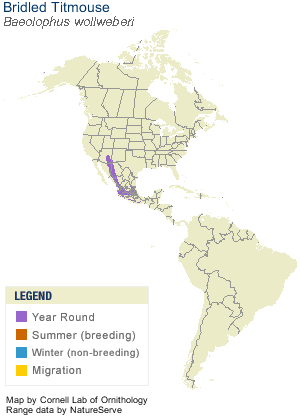
Texas also does not have Bridled Titmice. Here is a range map.
Both of the above have not been recorded in Texas at all.
Only Black-crested, Tufted, and Juniper have been recorded in the state.
The latter is remarkably isolated within the state and the former two hybridize all over their overlap zone. A frustrating topic, to be sure!

So to discuss the ranges of Baeolophus atricristatus (Black-crested), Baeolophus bicolor (Tufted), and Baeolophus ridgwayi (Juniper), let's start with the image below.


The above is a beautiful comparison of North American titmice, their faces and their ranges (though Black-crested does range a bit more NW than they show, making it into the Davis Mountains), via Cornell's Project Feeder Watch page on name changes.

The Guadalupe Mountains of far West Texas does harbor a population of Juniper Titmice (where they are also listed as an irruptive species), but their range in Texas stops there. Period. The rest of Texas is free of Juniper Titmice. Black-crested Titmice do not tend to overlap with Juniper at all, leaving little room for speculation of hybridization. New Mexico birders, unfortunately, must keep dreaming.

This leaves Black-crested Titmice ranging from the mountains in West Texas (but not the Guadalupes - this is why we distrust eBird maps) well into central and South Texas. Frustratingly, there is a large hybrid zone in central Texas along the swath of Tufted Titmouse range. The latter is highly unlikely to end up in West Texas, so they are not our primary focus.

Juniper Titmouse is the contested creature. Thankfully, eBird now has filters for Juniper Titmice in the Trans-Pecos region (but not the Panhandle?), but there are about a dozen reports from Brewster County. None on eBird, interestingly enough, from the Davis Mountains or Jeff Davis county - a gap in what would otherwise bridge the sightings. The reports from Brewster Co., with one exception ("Marathon"), are from Big Bend National Park and mostly in the Chisos. Aside from young Black-crested Titmice in summer that could look a bit confusing, winter reports were perhaps birds that were heard only and not seen? Or enthusiastic individuals who thought the habitat not fit for Black-crested jumped to conclusions? This is all speculation, but apparently so are the reports... and this is a nice summary of why citizen science is what it is. Thankfully the regional editors have changed the Juniper Titmouse status on eBird and any sightings outside of the Guadalupe Mountains will be 'flagged' for review. But until the filters are ironed out, folks hoping to find Juniper Titmice may see what appears to be an isolated year-round population in the Chisos Mountains (via the eBird map) and jump to some interesting conclusions.

From the Texas Bird Breeding Atlas Juniper Titmouse page:
DISTRIBUTION. During the 1987-1992 TBBA field work atlasers found 3 possible and 2 probable breeding records near the Guadalupe Mountains of Trans-Pecos Texas. Nesting was first discovered here in 1973, providing the first breeding record for this state. Reports of this species from other parts of west Texas are probably actually young Black-crested Titmice (B. atricristatus) which acquires its fully black crest as late as its second year after hatching, progressing through gray to dull brown tipped with gray (Oberholser 1974). The species has been reported from the Davis Mountains but breeding has not been documented there (Lockwood and Freeman 2004).

Folks have posted really lovely summaries of why presence/absence 'counting' is slightly ridiculous* and Juniper Titmice are also a good example of that. While we are certainly guilty of listing "X" for a species, even ONE Juniper Titmouse anywhere outside of the Guadalupe Mts is pretty phenomenal. So eBird reports from the park that list "X" or "2" should be scrutinized. Notes, photos and extensive documentation would be appropriate. Ideally, any of the reports would have had some sort of note - heard only, photo'd, or otherwise.

* Fantastic references for counting, via eBird:
Bird Counting 101
Bird Counting 201

Someday we'll have 'compact counting' tips posted as well, but that's more fodder for future posts!

Sunday, April 1, 2012

Post Park, morning of 1 April 2012


Black-chinned Hummingbird (Archilochus alexandri), female.

Nest-building.


A harsh "chuck" ended up being a Louisiana Waterthrush. We had one at Post Park last yr, too. Finally saw a Nashville Warbler, as locations in south Brewster Co. had been reporting them.

FOS Bell's Vireo was finally heard. Rio Grande Village had been reporting them down south. That BEVI vocalization will now never stop until well into the fall. Non-stop until it's gone, it always seems. Sounds like "heat haze" to me. :-)

Blue-winged Teal joining a few Ring-necked Ducks was also nice. As is customary at Post, the spring season has the place dripping with Vermilion Flycatchers. Absolutely everywhere. I also estimate conservatively on its count. A few spend the winter.

A pair of Green-tailed Towhees did not exactly express too much of a readiness to head north. There are some localized nesting in the mountains, some yrs. It would be of great coolness if a pair actually did so at Post..

Also Brown Thrasher and Spotted Towhee continues. We'll see for how long. Could be awhile.

No Lark Buntings. Only a couple White-crowned Sparrows. One Brewer's Sparrow. Winter residents are thinning out.

Several Black-chinned Hummingbirds in nest-building stage. It was entertaining to watch one particular female mend in spider-web to a nearing-completion nest structure.

The following is an ebird generated list of what species were observed this morning:

Marathon- Ft. Peña Colorado Pk (The Post)(FWTX 28), Brewster, US-TXApr 1, 2012 9:15 AM - 10:35 AMProtocol: Traveling1.0 mile(s)

37 species

Blue-winged Teal 2
Ring-necked Duck 3
Turkey Vulture 10
American Coot 3
White-winged Dove 10
Black-chinned Hummingbird 5 at least two were nest-building
Golden-fronted Woodpecker 7
Yellow-bellied Sapsucker 1
Red-naped Sapsucker 1
Ladder-backed Woodpecker 3
Northern Flicker 1 Red-shafted
Vermilion Flycatcher 8
Ash-throated Flycatcher 1 heard only
Bell's Vireo 1 FOS. Heard only.
Barn Swallow 9
Cactus Wren 3
Marsh Wren 3 3 singing males. Likely additional birds.
Blue-gray Gnatcatcher 1 heard only
Ruby-crowned Kinglet 1
Northern Mockingbird 4
Brown Thrasher 1
European Starling 1
LOUISIANA WATERTHRUSH 1 FOS
Nashville Warbler 1 FOS
Yellow-rumped Warbler 2
Myrtle'sGreen-tailed Towhee 2 would be nice if end up a nesting pair...
Spotted Towhee 1 heard only.
Canyon Towhee 1
Chipping Sparrow 4
Brewer's Sparrow 1
Lincoln's Sparrow 3
White-crowned Sparrow 2
Northern Cardinal 2
Pyrrhuloxia 6
Red-winged Blackbird 1
House Finch 10
American Goldfinch 2 heard only.