Tuesday, November 30, 2010

This week in Brewster Co.

This is something of a week report (generated by eBird) but numbers were scrambled with their less than blog-friendly format... you can see where this is going! So here it is: species only, with unusual birds in bold.

Most sightings are from Rio Grande Village, a few from Boquillas Canyon and the entry road to BBNP from Persimmon Gap (the north side). Dates primarily include Sunday, Nov. 28 and Tuesday, Nov. 30th. Had the northern side of the county been included, Allen's Hummingbird would be on the eBird list as well, it's visiting a feeder in Marathon.

Mallard (Mexican)
Scaled Quail
Horned Grebe
Black Vulture
Cooper's Hawk
American Kestrel
White-winged Dove
Inca Dove
Greater Roadrunner
Anna's Hummingbird
Golden-fronted Woodpecker
Ladder-backed Woodpecker
Tufted Flycatcher
Gray Flycatcher
Black Phoebe
Eastern Phoebe
Say's Phoebe
Vermilion Flycatcher
Ash-throated Flycatcher
Common Raven
Verdin
Brown Creeper
Cactus Wren
Rock Wren
Bewick's Wren
Blue-gray Gnatcatcher
Golden-crowned Kinglet
Ruby-crowned Kinglet
Hermit Thrush
Northern Mockingbird
American Pipit
Phainopepla
Orange-crowned Warbler
Yellow-rumped Warbler
Black-throated Gray Warbler
Canyon Towhee
Black-throated Sparrow
Northern Cardinal
Pyrrhuloxia
House Finch

Notes:

Butterflies:
Common Mestra
Variegated Fritillary
Queen
Texan Crescent
Reakirt's Blue
Fatal Metalmark
Checkered White
Orange Sulphur
Tawny Emperor
Common Buckeye
Tropical Buckeye
Dainty Sulphur
Western Pygmy Blue
Vanessa sp

Mammals:
Bobcat
Coyote
Desert Cottontail


Edit: Allen's Hummingbird photos upon request (HY male).


Hopefully better pics soon to come...

Tufted Flycatcher Nov. 30

EDIT: Video is up! Click here.

This morning (Tues, Nov. 30, 2010) we arrived at Daniels Ranch at 7:15 and split up to cover more ground; each with radio in hand, we covered from the adobe/mud brick house all the way to the eastern edge of the grove nearest to the RVs. A fellow from IN showed up a bit later and thankfully had a radio as well, so we were all in communication.

Matt located the Tufted Flycatcher at 8:05 and radioed to the rest of us as more birders converged in the vicinity (Peggy and RP, on their third TUFL watch). Another set of fellows from Austin/Bastrop joined us almost as soon as the bird was found and we were all able to watch and photograph it until our group dispersed an hour later. It was foraging in the cottonwood grove between the river and the road in the corner closest to the old adobe-style (mud brick?) ranch house. The grove is not to be confused with the picnic area just adjacent to the house, however.

Blogger keeps eating the video - three tries now - but to tide you over until the video gets sorted out:


Edit 2: other sightings from the park this week have now been posted here.

For continued NARBA updates, click here.

Edit 3: Shaky tufted awesome.

Monday, November 29, 2010

Rarities in the sidebar

A thought that had been in the works has been scooted into motion: our blog sidebar now has a 'regional rarity' feature (if you're reading this via RSS feed, you'll have to click over to the blog).

This was prompted by the first second Texas record for Tufted Flycatcher since the initial documentation in 1991. For up-to-date reports on the critter, NARBA is detailing reports and many folks are posting their sightings on Texbirds as well.

Until next time:

NARBA's link to Matt VanWallene's photos - kudos to him for immediately reporting a bird not in his field guide! He spotted it on Nov. 21, and it was confirmed by the 23rd.

Carolyn Ohl's post and photo

...we missed the flycatcher on Sunday afternoon and will be trying again on Tuesday morning. Fantastic things show up in your own back yard, you just have to be out of state for it to happen, no? =)

[edit]

Saturday, November 20, 2010

Two among the flighted

One, about to begin its initial ascent.
The other, stuck perhaps its final descent.

November butterflies are great. It can get darn cold in the evenings here in the high-desert grassland fall. It can be incredibly windy in the far of West Texas.
No matter for the fragile cold-blooded.

They remain.

I came across a Theona Checkerspot (Chlosyne theona) individual just entering its adult stage.

This butterfly's wings are wrinkled because it recently emerged. Its wings are still drying, warming, and blood reaching the veins.

The previous night was in the low 30s. Amazing. Newly reached adulthood in mid-November and found a small patch of sun under an Acanthus.

**By the way, I safely removed it only momentarily, then responsibly put it back**


In the end, I put it back where I found it; on that small patch of sun under a little shrub. It shook it wings vigorously from time to time. Eventually, it smoothed out the final wrinkled tip of a forewing.


Welcome to the world of flight; cold-blooded friend. Welcome to late November.

Now to an individual that has known this world. A world growing colder....


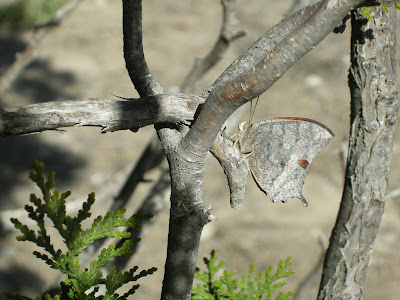
Tropical Leafwing (Anaea aidea)
An excellent butterfly species whose under sides resemble dead leaves; they are fond of crotons as young-ins.

This individual was very worn. The photos mask the fraying in the wings. Though, we can see through a section of missing wing, exposing a peek at the bright-orange upper-side of the opposite wing.


Leafwings rarely visit flowers, preferring tree sap, mud, and rotting fruit. There is sap on this juniper and we hang old fruit in a mesh bag from this location.

Interestingly, we first found this old bug proboscis-deep in our hummingbird feeder.


Two insects teetering on opposite ends of a flighted adult stage. I wonder what wisdom and sage advice this old leafwing might communicate to the young checkerspot. Or the young to the old?

Perhaps only that it is nice to have sun in November.

Monday, November 15, 2010

Trans-Pecos Christmas Bird Counts

The 'Christmas Bird Count' or CBC is a long tradition (see wiki link here) among birders. Perks? It encourages birding during an under-birded time of year as well as covering areas that aren't always included in casual birding. It's essentially a citizen-based bird census that takes place all over the continent between December 14th and January 5th.

Why not celebrate the New Year in a gorgeous part of the state while contributing to science? CBCs are great for people with all levels of bird interest - there's ample opportunity to learn and just because you can't identify them doesn't mean you can't spot them! Also, note-takers are in high demand (without notes, what data have you got?)

For more CBCs check out Houston Audubon's list of Texas Christmas Bird Counts for 2010-2011

In the Big Bend region, we've got a few to CBCs consider:

Sat. Dec. 18 - Davis Mountains

Sun. Dec. 19 - Balmorhea

Contact for both: Marty Hansen, birdsinflight/at/mac.com

Tues. Dec. 28 - Chisos Basin (Big Bend National Park)
Meet at 7:30 am in the visitor center, reconvene in the evening at the Panther Junction auditorium (around 6:00 PM) to compile the day's counts , pay registration fees, and prepare for the next day count.

Weds. Dec. 29 - Rio Grande Village (Big Bend National Park)
Meet at 7:30 am at the Rio Grande Village store. Meet again at Panther Junction auditorium to compile the list in the evening.

Contact for both BBNP counts: Mark Flippo, Mark_R_Flippo/at/nps.gov

Sat. Jan. 1 - Guadalupe Mountains
It is worth noting the dire situation for the Guadalupe Mountains CBC:

We have tried to set our count as the last Saturday of the count period every year so that people can routinely make plans. We would welcome the help. Several of our routine participants have died, moved away, aged to the point of not being able to do the hiking, etc., so I have been crying for help over the past couple of years. In the winter some of the park apartments or RV pads are vacant and I can usually offer a place to stay for $8 a person a night so participants can be here at dawn. Stay in touch and let me know if you or others can join us so I can pre-assign coverage areas. Thanks.
Contact: Fred Armstrong, Fred_Armstrong@nps.gov


Note on dates:
Counts used to start on the "second Saturday in December" and then it was changed to Dec. 14 regardless of day, causing a lot of conflict in areas that have many counts but not enough birders to go around! So when living on the Upper Texas Coast, I could do nearly 20 counts in one season because of ample weekend counts - when the dates changed and counts started to overlap, I was only able to do maybe eight. With only five counts out here, I sure hope there's good attendance!

Thursday, November 11, 2010

Metallica

Metalmarks (family Riodinidae)
"Scintillant" Metalmarks (genus Calephelis)


Fatal Metalmark (Calephelis nemesis)
Hmmm, ... species name is nemesis. Makes me wonder if the original voucher hunter saw it, looked down to get his or her glasses, looked back and could not find it again; at least for awhile.

"Scintillant" metalmarks are quite small butterflies. Usually only one, perhaps a second, in large expanses of nectar sources. If in the shadow of a leaf, probably passed by. Spotted by the casual observer, likely thought to be a boring little brown bug.

However, if one has the opportunity to look closer. Closer, still...
They have a narrow but amazing blue-silver metallic postmedian and submarginal band.


"Common", though possibly often missed, from the southern half of Arizona to the southwestern half of Texas. They are some of the more difficult butterflies to identify. Thankfully, I guess.., (C. nemesis) is the only scintillant we get in the Big Bend Region. However, if you think you have found a different species, show me...


Fatal Metalmark with a "Cuckoo Wasp"(family Chrysididae)

Incidentally, Cuckoo wasps make up a family of small, metallic wasps. They are sting-less, by the way. They are mostly parasites in the nests of other wasps or bees.

A final flight of adults before the cold snap? ...

"For whom the bell tolls, time marches on" - Metallica, Ride the Lightening, some year back before they cut their hair and went soft. You know, the good years.